Spectral gating denoiser with a learnable noise profile. More...
#include "../Core/AudioBuffer.h"#include "../Core/AudioSpec.h"#include "../Core/DspMath.h"#include "../Core/SpectralProcessor.h"#include "../Core/StateBlob.h"#include <algorithm>#include <atomic>#include <cmath>#include <cstddef>#include <cstdint>#include <vector>
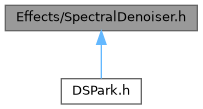
Go to the source code of this file.
Classes | |
| class | dspark::SpectralDenoiser< T > |
| Learn-a-profile spectral gate (hiss/hum/room-tone reduction). More... | |
Namespaces | |
| namespace | dspark |
| Main namespace for the DSPark framework. | |
Detailed Description
Spectral gating denoiser with a learnable noise profile.
Classic broadcast noise reduction on the SpectralProcessor STFT pipeline:
- Learn: while learning is enabled, the per-bin magnitude of the incoming signal (noise only - e.g. a second of room tone) accumulates into a noise profile (running maximum with a soft average).
- Gate: each bin whose magnitude falls below
threshold *profile is attenuated by up toreductiondB. Gains are smoothed over time per bin (fast attack, slow release) and across frequency (3-bin averaging), the standard defenses against musical noise.
Latency is the STFT's (fftSize samples). All per-bin state is per channel. The temporal release coefficient is per STFT hop, so the release time in milliseconds scales with fftSize/sampleRate (about 70 ms at the 2048 default and 48 kHz).
Threading model: parameter setters/getters are std::atomic based and safe from any thread (non-finite values are ignored). prepare() is setup-thread only (allocates; invalid specs are ignored and an unprepared instance passes audio through). reset() and clearProfile() belong to the stream owner (the profile is written by the audio thread while learning). getState()/setState() are setup/UI threads. Channels beyond the prepared count pass through dry (SpectralProcessor behaviour).
Dependencies: Core/SpectralProcessor.h, Core/AudioSpec.h, Core/AudioBuffer.h, Core/DspMath.h, Core/StateBlob.h.
Definition in file SpectralDenoiser.h.