World-class 16-line FDN reverb with Jot absorption and Hadamard mixing. More...
#include "../Core/RingBuffer.h"#include "../Core/DryWetMixer.h"#include "../Core/DspMath.h"#include "../Core/AudioSpec.h"#include "../Core/AudioBuffer.h"#include "../Core/DenormalGuard.h"#include "../Core/Biquad.h"#include "../Core/StateBlob.h"#include <algorithm>#include <array>#include <atomic>#include <cmath>#include <cstddef>#include <cstdint>#include <utility>#include <vector>
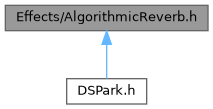
Go to the source code of this file.
Classes | |
| class | dspark::AlgorithmicReverb< T > |
| 16-line FDN reverb with Jot absorption and 6 presets. More... | |
| struct | dspark::AlgorithmicReverb< T >::SmoothRandomLFO |
| Hermite-interpolated random noise generator for organic modulation. More... | |
| struct | dspark::AlgorithmicReverb< T >::CachedParams |
| struct | dspark::AlgorithmicReverb< T >::PresetValues |
Namespaces | |
| namespace | dspark |
| Main namespace for the DSPark framework. | |
Detailed Description
World-class 16-line FDN reverb with Jot absorption and Hadamard mixing.
Architecture:
Key features:
- Jot absorption filter (Jot 1991): 1st-order pole-zero shelving IIR per delay line for smooth frequency-dependent decay, the #1 factor for natural sound. DC and Nyquist gains anchor the mid/HF T60 exactly; the transition sits at the high crossover. Separate bass shelf for independent LF control.
- Householder 16x16 FDN feedback (I - (2/N)J): unitary reflection, eigenvalues {-1 once, +1 x15}, |lambda|=1 so it is lossless and zero-coloring. (The Hadamard 16x16 below is the input diffuser's mix, not the feedback matrix.)
- Parallel allpass diffuser (Signalsmith-inspired): 16 parallel allpass
- 2-step Hadamard mixing (all eigenvalues +/-1) -> 256 unique echo paths per input sample. Each FDN line receives a different, densely-mixed version of the input.
- Feedback allpass: 2 regular allpass per delay line for in-loop density
- Output diffusion: 2 allpass per channel with decorrelated delays, smears residual temporal patterns
- Smooth random modulation (Lexicon-style): Hermite-interpolated noise replaces periodic sine LFOs for organic character
- Multi-tap output (Dattorro-style): 7 taps/channel from different delay line positions for true temporal decorrelation
- Tone correction EQ: Biquad high/low cut (12 dB/oct) for tonal shaping
- Early reflections: 40-tap with progressive frequency absorption simulating wall absorption; late taps are naturally darker
- Soft saturation: fast branchless rational soft-clip (transparent below +/-1), more musical than a hard clamp, prevents pipeline stalls.
- Allpass interpolation: in modulated FDN reads, preserves HF over hundreds of feedback iterations (linear/cubic causes cumulative dulling)
- Stereo width: M/S width control on late reverb tail
- Eco quality mode (setQuality): opt-in reduced engine (8 FDN lines, control-rate modulation, linear allpass interpolation, no extra output taps, single-stage input scatter, 12 early taps) at a fraction of the CPU cost, for embedded and other constrained targets. The default Full quality path is bit-identical to previous releases.
Threading: prepare() belongs to the setup thread (allocates). processBlock(), processSample() and reset() belong to the audio thread. All setters are lock-free atomic publications, safe from any thread; topology changes (type, quality) and coefficient refreshes are drained at the start of the next processBlock()/processSample() on the audio thread. Non-finite setter arguments are ignored.
Four levels of API complexity:
- Level 1:
reverb.setType(Hall); - Level 2:
reverb.setSize(0.7f); reverb.setDamping(0.3f); - Level 3:
reverb.setHighDecayMultiplier(0.4f); - Level 4: Inherit and override protected members.
References:
- Jot & Chaigne (1991): FDN with frequency-dependent decay (shelving absorption)
- Dattorro (1997, JAES): multi-tap output, plate topology
- Griesinger / Lexicon 480L: random modulation, Spin/Wander
- Sean Costello / Valhalla DSP: practical FDN design, absorbent allpass
- Valimaki et al. (2012, IEEE): "50 Years of Artificial Reverberation"
- Smith (CCRMA): Hadamard matrices, prime power delay selection
Dependencies: RingBuffer.h, DryWetMixer.h, DspMath.h, Biquad.h, AudioSpec.h, AudioBuffer.h, DenormalGuard.h, StateBlob.h.
Definition in file AlgorithmicReverb.h.