True-stereo 32-line FDN reverb with exact per-band decay and 6 presets. More...
#include <AlgorithmicReverb.h>
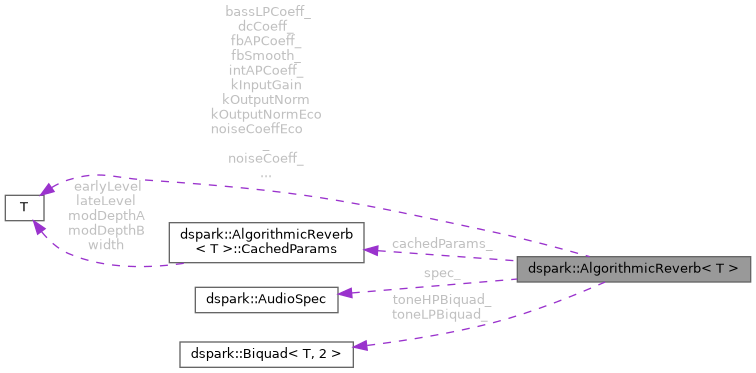
Classes | |
| struct | CachedParams |
| Block-cached copies of the atomics read in the sample loop. More... | |
| struct | DecayBand |
| One band of the decay equalizer. More... | |
| struct | DelayBank |
| Equal-size delay lines in one contiguous buffer sharing a write index (every line is written once per sample): at(i, k) is the sample line i received k samples ago. More... | |
| struct | Line |
| Power-of-two circular delay line: at(k) is the sample pushed k samples ago. More... | |
| struct | PlateTank |
| struct | PresetValues |
| struct | PublishedDecayBand |
| struct | SecondSlope |
| struct | SegmentLfo |
| Modulation by segments: a straight move toward the other side, a random share (0.3 to 0.95) of the way to its limit, at a random speed (each segment 0.5 to 1.5 cycles of the rate), then the next; the output follows the segments through a critically damped second-order filter (at twice the rate, 0.2 to 20 Hz), so the delay and its rate of change are continuous. More... | |
| struct | SmoothRandomLFO |
| struct | Wall |
| Hermite-interpolated random noise generator for organic modulation. More... | |
Public Types | |
| enum class | Type { Room , Hall , Chamber , Plate , Spring , Cathedral } |
| Reverb type presets. More... | |
| enum class | Quality { Full , Eco } |
| Engine quality / CPU cost trade-off (see setQuality()). More... | |
| enum class | DecayShape { Off , Bell , LowShelf , HighShelf } |
| Shape of a band of the decay equalizer (setDecayBand()). More... | |
| enum class | NoteValue { Off , Whole , Half , Quarter , Eighth , Sixteenth , ThirtySecond } |
| A note value for the tempo-synced times. More... | |
| enum class | NoteFeel { Straight , Dotted , Triplet } |
| The feel of a note value. More... | |
| enum class | WidthLaw { Side , PowerKept } |
| How the output width acts (setWidthLaw()). More... | |
| enum class | ModulationStyle { Smooth , Segments } |
| How the lines' lengths wander (setModulationStyle()). More... | |
| enum class | SpaceLayout { Prime , Geometric } |
| How the line lengths are laid out (setSpaceLayout()). More... | |
Public Member Functions | |
| ~AlgorithmicReverb ()=default | |
| void | prepare (const AudioSpec &spec) |
| Prepares the reverberation engine and allocates required memory. | |
| void | processBlock (AudioBufferView< T > buffer) noexcept |
| Processes an audio block in place with zero allocations. | |
| std::pair< T, T > | processSample (T input) noexcept |
| Processes a single mono sample and returns the wet stereo pair. | |
| void | reset () noexcept |
| Clears all delay lines and filter states and restarts the modulation, snapping any length glide to its target. | |
| void | setType (Type type) noexcept |
| Loads the selected preset baseline. | |
| void | setQuality (Quality q) noexcept |
| Selects the engine quality / CPU cost trade-off. | |
| void | setDecay (T seconds) noexcept |
| Mid-frequency reverberation time in seconds (0.1 - 30). | |
| void | setMix (T dryWet) noexcept |
| Dry/wet mix (0 = dry, 1 = wet). The wet signal is calibrated to the dry one's level: on pink noise at full mix it sits within about a decibel of it at every type's preset, and within -1 to +3.5 dB as the decay goes from 12 s down to 0.3 s and the size changes (its energy grows with the decay; a gain from the decay and the mean round trip takes that back). | |
| void | setSize (T size) noexcept |
| Room size (0.01 - 1). Scales the delay lines from 36% to 100% of their base lengths. A change cross-fades two read heads, the old lengths to the new, over a quarter of a second (no click and no glide of pitch; the next change waits for the fade), so the size can be automated. | |
| void | setDamping (T amount) noexcept |
| Sets high-frequency damping (0 = bright, 1 = dark). | |
| void | setPreDelay (T ms) noexcept |
| Pre-delay before the early reflections, in ms (0 - 500); a note value set by setPreDelayNote() takes its place. | |
| void | setDiffusion (T amount) noexcept |
| Diffusion (0 - 1): the strength of the input, in-loop and output allpass diffusers, and how many of the first early reflections stay discrete (7 at 0, 1 at 1). High values give a smooth, dense onset; low values keep crisp, localisable early echoes. For Type::Spring it sets the strength of the chirp. The allpass coefficients glide over about 20 ms. | |
| void | setModulation (T amount) noexcept |
| Modulation depth (0 - 1) of the delay-line wander. It smears the tail's resonances; 0 is fully static, 1 is a strong chorus. The depth is defined in time and scales with the room size. | |
| void | setWidth (T width) noexcept |
| Sets stereo width of the late reverb tail. | |
| void | setErToLateDelay (T ms) noexcept |
| Extra gap between the early reflections and the late tail, in ms (0 - 200). | |
| void | setHighDecayMultiplier (T mult) noexcept |
| Sets HF decay as a multiplier of mid decay time. | |
| void | setBassDecayMultiplier (T mult) noexcept |
| Sets bass decay as a multiplier of mid decay time. | |
| void | setHighCrossover (T hz) noexcept |
| Frequency where the HF decay transition is centered. | |
| void | setAirAbsorption (T amount) noexcept |
| The absorption of the air inside the tank, on top of the walls' (opt-in; the network types). | |
| T | getAirAbsorption () const noexcept |
| void | setBassCrossover (T hz) noexcept |
| Frequency where the bass decay transition is centered. | |
| void | setEarlyLevel (T dB) noexcept |
| Early reflections level in dB (-60 to +6). 0 dB is the physical balance: the early field then carries the late field's energy density and decay, so the two join on one exponential at any size and decay time. Changes glide over about 20 ms. | |
| void | setLateLevel (T dB) noexcept |
| Late tail level in dB (-60 to +6). Changes glide over about 20 ms. | |
| void | setModRate (T hz) noexcept |
| Modulation rate in Hz (0.1 - 5); each line wanders at its own multiple. | |
| void | setToneLowCut (T hz) noexcept |
| Sets a post-reverb low-cut filter on the wet signal (12 dB/oct). | |
| void | setToneHighCut (T hz) noexcept |
| Sets a post-reverb high-cut filter on the wet signal (12 dB/oct). | |
| void | setDecayBand (int index, const DecayBand &band) noexcept |
| One band of the decay equalizer: the decay time in a band of frequencies, as a multiple of what the other controls give there. | |
| DecayBand | getDecayBand (int index) const noexcept |
| void | setTailHold (bool on) noexcept |
| Holds the tail: the input to the tank and the early field fade out over about 20 ms while every loop's absorption and decay band fade to unity, so the tail holds with its highs. Off fades back. | |
| bool | isTailHeld () const noexcept |
| void | setDryDip (T dB) noexcept |
Dips the wet signal under the dry one while it plays (see TailShaper): by up to dB (0 to 48; 0, the default, is off), in proportion to the dry level against its own recent peak. | |
| void | setGate (T thresholdDb) noexcept |
Gate on the wet signal (see TailShaper): it closes once the dry signal has stayed thresholdDb under its recent peak (-80 to 0; below -80, the default, the gate is off) for the hold time. | |
| void | setGateHold (T ms) noexcept |
| Hold of the gate, 0 to 4000 ms (default 100); a note value set by setGateHoldNote() takes its place. | |
| void | setGateRelease (T ms) noexcept |
| Release of the gate, 5 to 4000 ms (default 150). | |
| void | setSourceDepth (T amount) noexcept |
| Depth of the source in the room, 0 to 1 (0, the default, is off): one control that moves the balance from the early reflections (down to half) to the tail (up by half), shortens the pre-delay (to a fifth at 1), adds input diffusion (with its square, up to 0.25) and darkens the wet signal with a one-pole low-pass from 18 kHz down (to 2.25 kHz at 1, further with a darker HF decay). Non-finite values are ignored. | |
| void | setTankLeveling (T amount) noexcept |
| Leveling of the tank, 0 to 1 (0, the default, is off): a compressor on the tank's input (ratio 1 + 3 x amount over -30 dBFS with a 24 dB knee), its gain compensated at -18 dBFS: quiet passages feed the tail as much as loud ones. It reads the peak of each sample (as the power of a sine with that peak); its reduction deepens at once, holds 30 ms and comes back with a time constant of half a second, so it neither moves within a cycle of a low note nor lets the start of a hit through. Non-finite values are ignored. | |
| void | setTankSaturation (bool on) noexcept |
| Soft saturation after the leveling compressor (off by default). | |
| void | setTempo (T bpm) noexcept |
| Tempo for the note values, 20 to 400 BPM (default 120). | |
| void | setPreDelayNote (NoteValue note, NoteFeel feel=NoteFeel::Straight) noexcept |
| Pre-delay as a note value at the tempo (Off, the default, uses setPreDelay()); up to 500 ms. | |
| void | setGateHoldNote (NoteValue note, NoteFeel feel=NoteFeel::Straight) noexcept |
| Gate hold as a note value at the tempo (Off, the default, uses setGateHold()); up to 4 s. | |
| void | setInputWidth (T width) noexcept |
| Width of the input, 0 to 1 (1, the default, is the input as it is): the side of the input is scaled before the tank, so a wide source excites the room from nearer the centre. | |
| void | setWidthLaw (WidthLaw law) noexcept |
| How setWidth() acts on the tail: Side (the default) scales the side; PowerKept also raises the middle as the side falls (sqrt(2 - width^2)), so the tail's power stays the same from 0 to 1.41. | |
| void | setPostEqBand (int index, const typename KeyEqualizer< T, 2 >::Band &band) noexcept |
| One band of the wet signal's equalizer (KeyEqualizer bands). | |
| void | setPostEqLoudness (bool on) noexcept |
Keeps the loudness of the wet signal through its equalizer (off by default; see KeyEqualizer::setLoudnessCompensation()). State key postloudness. | |
| bool | getPostEqLoudness () const noexcept |
| KeyEqualizer< T, 2 >::Band | getPostEqBand (int index) const noexcept |
| void | setModulationStyle (ModulationStyle style) noexcept |
| How the line lengths wander: Smooth (the default) is the smooth random modulation of every line; Segments moves every other line in segments that alternate sides, toward random positions at random speeds (each segment 0.5 to 1.5 cycles of the line's rate), rounded by a critically damped follower so the pitch has no corners, with the depth held under 2 % of the line's length. | |
| void | setSpaceLayout (SpaceLayout layout) noexcept |
| How the line lengths are laid out: Prime (the default) takes the tuned base lengths; Geometric spaces them evenly in log over the same range (about 6.6 per octave, the lines of the two sides interleaved half a step apart), then to the nearest prime. The read heads cross-fade to the new layout as on a change of size. | |
| void | setPlateTank (bool on) noexcept |
| The plate's own tank (off by default; Type::Plate only): the figure-eight of Dattorro's plate instead of the delay network. Two branches feed each other, each an all-pass that the modulation moves, a delay, the damping and the decay, a second all-pass and a delay; each side of the output is read at seven points inside the other branch and its own. Decay, high decay and its crossover, modulation and its rate follow the controls; a plate has one size, so Size does not change it, and Bass Decay does not reach it. The wet level is that of the network within 0.25 dB; the decay is the one asked within 5 % from 2 s up (a branch takes a third of a second, so at 1.5 s it is 12 % short). | |
| bool | isPlateTank () const noexcept |
| void | setDoubleSlope (T amount) noexcept |
| A second slope, 0 to 1 (0, the default, is off): beside the tank, four lines of its own decay in 0.3 of its times, so the first decibels of the tail fall faster than the rest, as in a hall coupled to a smaller space. At 1 the early decay time falls to 0.87 (Hall) to 0.90 (Room) of what it was, the T30 moves under 3 % and the energy of the tail under 0.2 dB. Not for Spring. Non-finite values are ignored. | |
| T | getDoubleSlope () const noexcept |
| void | setBandLimit (T hz) noexcept |
| Limits the band of the wet signal, as early digital reverbs did: an elliptic wall (order 12, 0.05 dB of ripple, 100 dB down a fifth of an octave above the corner) on the output, outside the tank, so the decay does not change. 0, the default, is off; otherwise 1 kHz up to 0.4 of the rate. A move fades over 20 ms (one during a fade waits for it). Non-finite values are ignored. | |
| T | getBandLimit () const noexcept |
| void | setShimmer (T amount) noexcept |
| Octave-up shimmer, 0 to 1 (0, the default, is off): the tail is pitched up an octave by two read heads with windows of random length (30 to 60 ms) and a raised-cosine crossfade, and fed back into the tank. Non-finite values are ignored. | |
| T | getDryDip () const noexcept |
| T | getGate () const noexcept |
| T | getGateHold () const noexcept |
| T | getGateRelease () const noexcept |
| T | getSourceDepth () const noexcept |
| T | getTankLeveling () const noexcept |
| bool | isThicknessSaturated () const noexcept |
| T | getTempo () const noexcept |
| NoteValue | getPreDelayNote () const noexcept |
| NoteValue | getGateHoldNote () const noexcept |
| T | getInputWidth () const noexcept |
| WidthLaw | getWidthLaw () const noexcept |
| ModulationStyle | getModulationStyle () const noexcept |
| SpaceLayout | getSpaceLayout () const noexcept |
| T | getShimmer () const noexcept |
| T | getEffectivePreDelay () const noexcept |
| Type | getType () const noexcept |
| Quality | getQuality () const noexcept |
| T | getDecay () const noexcept |
| T | getMix () const noexcept |
| T | getSize () const noexcept |
| T | getDamping () const noexcept |
| T | getDiffusion () const noexcept |
| T | getModulation () const noexcept |
| T | getModRate () const noexcept |
| T | getPreDelay () const noexcept |
| T | getErToLateDelay () const noexcept |
| T | getHighDecayMultiplier () const noexcept |
| T | getBassDecayMultiplier () const noexcept |
| T | getWidth () const noexcept |
| T | getHighCrossover () const noexcept |
| T | getEarlyLevel () const noexcept |
| Early reflections level in dB (as set, or the preset's). | |
| T | getLateLevel () const noexcept |
| Late tail level in dB (as set, or the preset's). | |
| T | getBassCrossover () const noexcept |
| std::vector< uint8_t > | getState () const |
| Serializes the parameter state (setup/UI threads; allocates). | |
| bool | setState (const uint8_t *data, size_t size) |
| Restores parameters from a blob (tolerant; rejects foreign ids). | |
Static Public Attributes | |
| static constexpr int | kDecayBands = 6 |
| Bands of the decay equalizer. | |
| static constexpr int | kPostBands = KeyEqualizer<T, 2>::kBands |
| Bands of the wet equalizer. | |
Protected Types | |
| enum | : uint32_t { kUserDecay = 1u , kUserSize = 2u , kUserDamping = 4u , kUserDiffusion = 8u , kUserBassDecay = 16u , kUserHighXover = 32u , kUserBassXover = 64u , kUserModDepth = 128u , kUserModRate = 256u , kUserEarly = 512u , kUserLate = 1024u , kUserErToLate = 2048u } |
| using | AirTaps = std::array< std::array< T, kMaxLines >, kAirTaps > |
Protected Member Functions | |
| int | msToSamples (T ms) const noexcept |
| void | markUserParam (uint32_t bit) noexcept |
| void | drainPendingChanges () noexcept |
| Drains deferred parameter changes on the audio thread. | |
| void | snapGlides () noexcept |
| Puts every gliding parameter (levels, width, diffusion, tone) at its target. | |
| void | drainTone () noexcept |
| void | advanceTone (T amount, T &hp0, T &lp0) noexcept |
| void | snapTone () noexcept |
| Puts the tone filters at their targets at once (prepare, reset). | |
| void | refreshCachedParams () noexcept |
| Pulls the atomic parameters into the block-local cache (audio thread). | |
| void | controlTick () noexcept |
| Control-rate update: glides the line lengths toward their targets, draws the next modulation values and sets the per-sample read-position ramps for the next kCtrl samples. | |
| void | beginSizeFade () noexcept |
| Opens the second read head of every line at the new lengths (with the wander the first one carries) and of every in-loop allpass at its new length; the two heads then cross-fade at constant power over kSizeFadeSeconds (far apart, what they read is uncorrelated). | |
| void | endSizeFade () noexcept |
| The fade is over: the second heads become the first. | |
| template<int N> | |
| void | runFdn (T &lateL, T &lateR, int injLag, T loopAPCoeff, T inGain, T extra) noexcept |
| One sample of the N-line FDN (compile-time N so the per-line stages vectorize): allpass-interpolated modulated reads, the L/R output sums, Hadamard mix plus rotation, absorption shelves, in-loop allpass, safety limiter, injection, write. | |
| void | designPlate (double decay, double t60H, double crossoverHz) noexcept |
| The plate tank's decay and damping. A branch takes its gain once a pass, from its own length; the damping is a one-pole low-pass whose loss at the high crossover makes the high decay asked for. Its tail sets the wet level as the network's does. | |
| void | runPlate (T &lateL, T &lateR, int injLag, T inGain, T extra) noexcept |
| One sample of the plate tank: the late pair, from the diffused feed. | |
| void | designSecondSlope (double decay, double t60H, double Kh) noexcept |
| The second slope's absorption and shares. Fed and summed as the tank is (unit energy in, every line out), a network's tail holds 1 / (e^(13.8 x its mean loop / T60) - 1) of energy; the share asked for sets its gain from the two, and the tank keeps the rest, so the sum has the tail's energy. | |
| void | runSecondSlope (T &lateL, T &lateR, int injLag) noexcept |
| One sample of the second slope, added to the late pair. | |
| void | advanceSizeFade () noexcept |
| One sample of a size fade; at its end the second heads become the first. | |
| template<int N, int W, typename O > | |
| void | applyDecayBands (T *r) noexcept |
| The decay bands in the loop, one TDF-II biquad per line and band (the per-line arithmetic runs across the lines in SIMD). | |
| template<int Springs, int Stages> | |
| void | runSprings (T &lateL, T &lateR, const T(&raw)[2]) noexcept |
| One sample of the spring tanks (Type::Spring): six springs per side (one in Eco), all of different lengths. | |
| void | refreshTopology () noexcept |
| Line count of the active engine: the springs, or the FDN size. | |
| void | processChunk (const T *inL, const T *inR, T *outL, T *outR, int count) noexcept |
| Core processing of up to kChunk samples: stereo in, wet stereo out. | |
| T | shimmerStep (T input) noexcept |
| One sample of the octave-up shimmer: two read heads, half a window apart, sweep the recent input at twice its speed, each under a raised-cosine window; a head draws its next window length (30 to 60 ms) as it wraps. | |
| double | drawShimmerLength () noexcept |
| void | applyHoldCoeffs () noexcept |
| The absorption and decay bands in use: the designed ones moved toward unity by the tail hold. | |
| void | setAirTaps (std::size_t l) noexcept |
| void | applyHoldShelves () noexcept |
| The shelves and decay bands of applyHoldCoeffs(). | |
| void | holdAbsorption () noexcept |
| The loop gains as they stand, kept for the ramp of a chunk. | |
| void | rampAbsorption (T perSample) noexcept |
| void | stepAbsorption () noexcept |
| One sample of the loop gains' ramp. | |
| std::pair< T, T > | outputStage (T lateL, T lateR, T earlyL, T earlyR, T earlyLevel, T lateLevel, T width, T toneHPMix, T toneLPMix, T outAPCoeff) noexcept |
| void | updateAll () noexcept |
| T | sizeFactor () const noexcept |
| Size factor: size 0 -> 0.35, size 1 -> 1. | |
| void | updateDelayLengths () noexcept |
| void | updateDiffCoeffs () noexcept |
| void | updateModulation () noexcept |
| void | updateDecayParams () noexcept |
| Per-line absorption: Jot mid/high shelf and bass shelf. | |
| void | snapAbsorption () noexcept |
| The absorption at its design at once (no glide). | |
| void | glideAbsorption (T gc) noexcept |
| void | refreshAirInUse () noexcept |
| double | heardTailEnergy (double decay, double t60H, double t60B, double Kh, double Kb) const noexcept |
| The energy of the tail for a unit of energy injected, as heard. At each frequency the first pass leaves each line attenuated by that line's own loop gain (the short lines first and louder), and what follows is the geometric series of the mean round trip: mean(g^2) / (1 - exp(-x)), x = 2 ln(1000) (mean round trip) / T60, which tends to T60 / (2 ln(1000) round trip) for a long decay. A spring is its own loop and its first pass is heard unattenuated: 1 + 1 / (exp(x) - 1). The loop gains are those just designed (the absorption, the bass shelf and the decay bands); the frequencies weigh as programme is heard (pink, through the loudness weighting: the low end out under about 40 Hz and 4 dB more over 2 kHz). | |
| double | earlyEnergy () const noexcept |
| The energy of the early field in the tail's units: the tail's own energy flow over the early window (see generateERTaps()). | |
| void | designDecayBands (double decay, double t60H, double t60B, double Kh, double Kb) noexcept |
| Designs the decay bands per line (audio thread at the drain, or prepare()): each band's gain from the line's own loop gain there, and the boosts scaled down together where they would lift the loop over kMaxDecayLoopGain. | |
| double | effectivePreDelayMs () const noexcept |
| The pre-delay in ms: the note value's time at the tempo, or the one set. | |
| void | refreshPreDelay () noexcept |
| void | refreshGateHold () noexcept |
| double | noteMs (int note, int feel) const noexcept |
| A note value's time at the tempo, in ms. | |
| double | calibratedMidDecay () const noexcept |
| The loop's DC decay that puts the ISO 3382 mid-frequency reverberation time on the decay setting. | |
| void | generateERTapsForType (Type type) noexcept |
| Regenerates the early-reflection taps for a reverb type (Eco caps the count). | |
| void | generateERTaps (double minMs, double maxMs, int numTaps) noexcept |
| Velvet-noise early field (Valimaki et al.): numTaps sparse +-1 impulses per side between minMs and maxMs, one per slot at a random position, denser as time goes on (density ~ t^0.6, like the rising echo density of a room). The first four are positive discrete reflections. Each tap reads its own side (probability falling from 0.85 to 0.5 over the window, so the field starts lateralised and turns diffuse) or the other. Amplitudes follow a decaying envelope normalised by the local density, so the energy flows smoothly into the late field; later tap groups pass darker absorption low-passes. The taps read the pre-diffused signal, so each reflection is itself a short dense burst. | |
| void | commitPreset (const PresetValues &p) noexcept |
| void | applyTopology (Type type) noexcept |
| void | applyPreset (Type type) noexcept |
Static Protected Member Functions | |
| static T | allpassCoeff (double d) noexcept |
| static double | springBaseMs (int s) noexcept |
| static constexpr T | lfoRateFactor (int i) noexcept |
| static constexpr uint32_t | lfoSeed (int i) noexcept |
| static constexpr T | rotRate () noexcept |
| static constexpr T | rotRateFactor (int i) noexcept |
| static constexpr uint32_t | rotSeed (int i) noexcept |
| static double | hash01 (int k, int s) noexcept |
| Deterministic hash in [0, 1) for the early-reflection layout. | |
| static T | levelDb (T gain) noexcept |
| Linear gain to dB (a zero gain, a preset's muted early field, reads -120 dB). | |
| static constexpr AirTaps | identityAirTaps () noexcept |
| static T | glideTo (T cur, T target, T amount) noexcept |
| static void | glideHz (double &cur, double target, double amount) noexcept |
| One glide step of a running cutoff toward its target (log domain). | |
| template<int M> | |
| static void | hadamardSmall (T *x) noexcept |
| template<int N, int W, typename O > | |
| static void | fwht (T *x) noexcept |
| static void | addTap (T *acc, const Line &l, int lag0, T gain, int count) noexcept |
| static void | writeSpan (Line &l, const T *src, int count) noexcept |
Pushes count samples into a line, in pieces that stop at its end. | |
| static void | diffuseSpans (Line &ap, int len, T g0, T gDelta, const T *ramp, T *x, int count) noexcept |
| One Schroeder allpass stage over a chunk: w = x + g d, out = d - g w, with g = g0 + gDelta ramp[n] at sample n of the chunk. | |
| static double | airAttenuationDbPerMetre (double hz) noexcept |
| The air's attenuation in dB per metre at 20 degrees C, 50 % relative humidity and one atmosphere (ISO 9613-1: the classical and rotational loss and the oxygen and nitrogen relaxations). | |
| static double | airDepth (double amount, double loopSeconds, double sr) noexcept |
The b of a line: its loss in decibels, 8.686 b (1 - cos w), at kAirFitHz is the air's over a round trip of loopSeconds, amount times the standard's. | |
| static double | shelfGain (double a, double b, double w) noexcept |
| static constexpr std::array< double, 2 > | earlyWindow (Type type) noexcept |
| The early reflections' window of a type, in ms (none: both zero). | |
| static double | biquadGain (const BiquadCoeffs &q, double w) noexcept |
| static const std::vector< uint8_t > & | getPrimeSieve () noexcept |
| static int | nearestPrime (int n) noexcept |
| Smallest prime >= n (lengths only grow by a few samples). | |
| static PresetValues | presetValues (Type type) noexcept |
| The parameter values of each preset. | |
Protected Attributes | |
| Wall | wall_ |
| std::atomic< T > | bandLimit_ { T(0) } |
| PlateTank | plate_ |
| std::atomic< bool > | plateTank_ { false } |
| SecondSlope | slope2_ |
| std::atomic< T > | doubleSlope_ { T(0) } |
| AudioSpec | spec_ {} |
| bool | prepared_ = false |
| bool | eco_ = false |
| int | nLines_ = kMaxLines |
| int | ctrlPhase_ = 0 |
| std::array< Line, 2 > | preDelay_ |
| std::array< std::array< Line, kInStages >, 2 > | inAP_ |
| std::array< std::array< int, kInStages >, 2 > | inAPLen_ {} |
| std::array< T, kInStages > | inAPCoeff_ {} |
| std::array< T, kInStages > | inAPCoeffTarget_ {} |
| inAPCoeff_ glides here (setDiffusion) | |
| std::array< Line, 2 > | ring_ |
| allpass-diffused input, feeds the late field | |
| std::array< std::array< Line, kOutStages >, 2 > | outAP_ |
| late-field output diffusers | |
| std::array< std::array< int, kOutStages >, 2 > | outAPLen_ {} |
| T | outAPCoeff_ = T(0.5) |
| T | outAPCoeffTarget_ = T(0.5) |
| int | numERTaps_ = 0 |
| reflections per output side | |
| int | numERSlots_ = 0 |
| tap slots per output side (see kMaxERSlots) | |
| Type | erType_ = Type::Room |
| std::array< std::array< int, kMaxERSlots >, 2 > | erTap_ {} |
| std::array< std::array< int, kMaxERSlots >, 2 > | erChan_ {} |
| std::array< std::array< int, kMaxERSlots >, 2 > | erBin_ {} |
| std::array< std::array< T, kMaxERSlots >, 2 > | erGain_ {} |
| current (gliding) tap gains | |
| std::array< std::array< T, kMaxERSlots >, 2 > | erGainTarget_ {} |
| gains for the current size/decay | |
| std::array< T, kERGroups > | erShelfGainTarget_ {} |
| T | erGlidePerSample_ = T(0.001) |
| glide rate of the two (1 / samples) | |
| std::array< std::array< int, kERGroups+1 >, 2 > | erGroupStart_ {} |
| slot index per side | |
| std::array< T, kERGroups > | erShelfGain_ {} |
| HF gain of each absorption group. | |
| T | erShelfCoeff_ = T(0.5) |
| one-pole coefficient at the high crossover | |
| std::array< std::array< T, kERGroups >, 2 > | erLP_ {} |
| std::array< std::array< T, kERGroups >, 2 > | erShadowLP_ {} |
| double | meanLoopSec_ = 0.1 |
| mean FDN round trip (s), for the early/late energy match | |
| T | wetLevel_ = T(1) |
| the wet signal's level against the decay (see updateDecayParams()) | |
| T | shadowCoeff_ = T(0) |
| DelayBank | lines_ |
| std::array< int, kMaxLines > | lenTarget_ {} |
| prime line lengths (samples) | |
| std::array< T, kMaxLines > | lenCur_ {} |
| gliding length | |
| std::array< double, kMaxLines > | pos_ {} |
| current read position | |
| std::array< double, kMaxLines > | posInc_ {} |
| per-sample ramp | |
| std::array< double, kMaxLines > | pos2_ {} |
| std::array< double, kMaxLines > | posInc2_ {} |
| std::array< T, kMaxLines > | apY2_ {} |
| std::array< T, kMaxLines > | lenNew_ {} |
| std::array< int, kMaxLines > | loopAPFrom_ {} |
| std::array< int, kMaxLines > | loopAPTo_ {} |
| double | fadeAt_ = 0.0 |
| double | fadeStep_ = 0.0 |
| the fade, 0 to 1, and its step per sample | |
| bool | sizeFade_ = false |
| std::array< T, kMaxLines > | apY1_ {} |
| allpass interpolator state | |
| std::array< int, kMaxLines > | injTap_ {} |
| std::array< T, kMaxLines > | injGain_ {} |
| sign / sqrt(lines) | |
| std::array< T, kMaxLines > | outSignL_ {} |
| std::array< T, kMaxLines > | outSignR_ {} |
| std::array< SmoothRandomLFO, kMaxLines > | lfo_ |
| std::array< SmoothRandomLFO, kMaxLines/2 > | rotLfo_ |
| std::array< T, kMaxLines/2 > | rotC_ {} |
| std::array< T, kMaxLines/2 > | rotS_ {} |
| T | rotDepth_ = T(0) |
| unsigned | rotTick_ = 0 |
| T | modDepthSamples_ = T(0) |
| T | glideCoeff_ = T(0) |
| T | maxGlideStep_ = T(0) |
| T | maxReadPos_ = T(8) |
| bool | spring_ = false |
| std::vector< T > | springHist_ |
| int | springP_ = 8 |
| int | springW_ = 0 |
| int | springK_ = 5 |
| int | springStages_ = kSpringStages |
| T | springA_ = T(0.5) |
| std::array< std::array< T, 5 >, 2 > | springLP_ {} |
| b0 b1 b2 a1 a2, two sections | |
| std::array< std::array< T, kSprings >, 4 > | springLPState_ {} |
| [section * 2 + state][spring] | |
| DelayBank | loopAP_ |
| std::array< int, kMaxLines > | loopAPLen_ {} |
| in-loop allpass target lengths | |
| std::array< T, kMaxLines > | loopAPCur_ {} |
| gliding lengths after a size change | |
| bool | loopAPGliding_ = false |
| T | loopAPCoeff_ = T(0.4) |
| T | loopAPCoeffTarget_ = T(0.4) |
| std::array< T, kMaxLines > | jotB0_ {} |
| std::array< T, kMaxLines > | jotB1_ {} |
| std::array< T, kMaxLines > | jotA1_ {} |
| std::array< T, kMaxLines > | jotX1_ {} |
| std::array< T, kMaxLines > | jotY1_ {} |
| std::array< T, kMaxLines > | bassB0_ {} |
| std::array< T, kMaxLines > | bassB1_ {} |
| std::array< T, kMaxLines > | bassA1_ {} |
| std::array< T, kMaxLines > | bassX1_ {} |
| std::array< T, kMaxLines > | bassY1_ {} |
| AirTaps | airTap_ = identityAirTaps() |
| AirTaps | airTapFrom_ {} |
| AirTaps | airTapStep_ {} |
| AirTaps | airHist_ {} |
| int | airW_ = 0 |
| int | airTapCount_ = 1 |
| taps that carry more than 1e-7 of the largest b's sum | |
| bool | airInUse_ = false |
| any line's b, designed, gliding or in use, above 0 | |
| std::array< T, kMaxLines > | airGoal_ {} |
| std::array< T, kMaxLines > | airBase_ {} |
| std::array< T, kMaxLines > | airNow_ {} |
| Biquad< T, 1 > | coherenceFilter_ |
| Biquad< T, 2 > | subsonicFilter_ |
| Biquad< T, 2 > | toneLPBiquad_ |
| Biquad< T, 2 > | toneHPBiquad_ |
| bool | toneLPActive_ = false |
| filter running (on, or still fading out) | |
| bool | toneHPActive_ = false |
| double | toneLPCurHz_ = 0.0 |
| double | toneLPTargetHz_ = 0.0 |
| double | toneHPCurHz_ = 0.0 |
| double | toneHPTargetHz_ = 0.0 |
| bool | toneLPOn_ = false |
| bool | toneHPOn_ = false |
| T | toneLPMix_ = T(0) |
| T | toneHPMix_ = T(0) |
| share of the filtered signal | |
| T | earlyCur_ = T(1) |
| T | lateCur_ = T(1) |
| T | widthCur_ = T(1) |
| bool | fresh_ = true |
| no sample processed since prepare()/reset() | |
| DryWetMixer< T > | mixer_ |
| std::atomic< Type > | type_ { Type::Room } |
| std::atomic< T > | decayTime_ { T(1) } |
| std::atomic< T > | size_ { T(0.5) } |
| std::atomic< T > | damping_ { T(0.5) } |
| std::atomic< T > | diffusion_ { T(0.7) } |
| std::atomic< T > | modDepth_ { T(0.1) } |
| std::atomic< T > | modRate_ { T(1) } |
| std::atomic< T > | preDelayMs_ { T(0) } |
| std::atomic< T > | erToLateMs_ { T(0) } |
| std::atomic< T > | mix_ { T(0.3) } |
| std::atomic< T > | earlyLevel_ { T(1) } |
| std::atomic< T > | lateLevel_ { T(1) } |
| std::atomic< T > | width_ { T(1) } |
| std::atomic< T > | highDecayMult_ { T(0.5) } |
| std::atomic< T > | bassDecayMult_ { T(1.2) } |
| std::atomic< T > | highCrossover_ { T(5000) } |
| std::atomic< T > | airAbsorption_ { T(0) } |
| std::atomic< T > | bassCrossover_ { T(200) } |
| std::atomic< Quality > | quality_ { Quality::Full } |
| std::atomic< int > | preDelaySamples_ { 0 } |
| std::atomic< int > | erToLateSamples_ { 0 } |
| std::atomic< bool > | presetDirty_ { false } |
| std::atomic< bool > | paramsDirty_ { false } |
| std::atomic< bool > | qualityDirty_ { false } |
| std::atomic< bool > | toneDirty_ { false } |
| std::atomic< T > | toneLowCutHz_ { T(-1) } |
| std::atomic< T > | toneHighCutHz_ { T(-1) } |
| std::atomic< uint32_t > | userParamMask_ { 0u } |
| CachedParams | cachedParams_ {} |
| std::array< PublishedDecayBand, kDecayBands > | decayBands_ |
| std::atomic< bool > | tailHold_ { false } |
| std::atomic< bool > | tankSat_ { false } |
| std::atomic< T > | sourceDepth_ { T(0) } |
| std::atomic< T > | tankLeveling_ { T(0) } |
| std::atomic< T > | tempo_ { T(120) } |
| std::atomic< T > | inputWidth_ { T(1) } |
| std::atomic< T > | shimmer_ { T(0) } |
| std::atomic< T > | gateHoldMs_ { T(100) } |
| std::atomic< int > | preNote_ { 0 } |
| std::atomic< int > | preFeel_ { 0 } |
| std::atomic< int > | gateNote_ { 0 } |
| std::atomic< int > | gateFeel_ { 0 } |
| std::atomic< int > | widthLaw_ { 0 } |
| std::atomic< int > | modStyle_ { 0 } |
| std::atomic< int > | layout_ { 0 } |
| TailShaper< T > | tail_ |
| KeyEqualizer< T, 2 > | postEq_ |
| std::array< std::array< T, kMaxLines >, 3 > | jotBase_ {} |
| std::array< std::array< T, kMaxLines >, 3 > | bassBase_ {} |
| std::array< std::array< std::array< T, kMaxLines >, kDecayBands >, 5 > | dqBase_ {} |
| std::array< std::array< T, kMaxLines >, 3 > | jotGoal_ {} |
| std::array< std::array< T, kMaxLines >, 3 > | bassGoal_ {} |
| std::array< std::array< std::array< T, kMaxLines >, kDecayBands >, 5 > | dqGoal_ {} |
| bool | absorbGlide_ = false |
| std::array< std::array< T, kMaxLines >, 6 > | absFrom_ {} |
| The loop gains' ramp across a chunk: where they stood and their step per sample. | |
| std::array< std::array< T, kMaxLines >, 6 > | absStep_ {} |
| std::array< std::array< std::array< T, kMaxLines >, kDecayBands >, 5 > | dqFrom_ {} |
| std::array< std::array< std::array< T, kMaxLines >, kDecayBands >, 5 > | dqStep_ {} |
| double | quietSamples_ = 1e300 |
| samples since input last entered the tank | |
| double | tankEmptyAfter_ = 0.0 |
| quiet samples after which the tank is under -120 dB | |
| std::array< std::array< T, kMaxLines >, kDecayBands > | dqB0_ {} |
| std::array< std::array< T, kMaxLines >, kDecayBands > | dqB1_ {} |
| std::array< std::array< T, kMaxLines >, kDecayBands > | dqB2_ {} |
| std::array< std::array< T, kMaxLines >, kDecayBands > | dqA1_ {} |
| std::array< std::array< T, kMaxLines >, kDecayBands > | dqA2_ {} |
| std::array< std::array< T, kMaxLines >, kDecayBands > | dqZ1_ {} |
| std::array< std::array< T, kMaxLines >, kDecayBands > | dqZ2_ {} |
| std::array< int, kDecayBands > | dqList_ {} |
| int | dqCount_ = 0 |
| T | holdNow_ = T(0) |
| double | levelGr_ = 0.0 |
| double | levelRelease_ = 0.0 |
| Tank leveling: the reduction (dB) and its release. | |
| int | levelHold_ = 0 |
| int | levelHoldSamples_ = 0 |
| Tank leveling: hold left and its length. | |
| std::array< T, 2 > | distLp_ {} |
| T | distCoeff_ = T(1) |
| T | distMix_ = T(0) |
| std::array< SegmentLfo, kMaxLines > | seg_ {} |
| std::vector< T > | shimBuf_ |
| int | shimMask_ = 0 |
| int | shimW_ = 0 |
| std::array< double, 2 > | shimPhase_ { 0.0, 0.5 } |
| std::array< double, 2 > | shimLen_ { 0.045, 0.045 } |
| uint32_t | shimRng_ = 0x51ED27u |
| T | lastLateMono_ = T(0) |
Static Protected Attributes | |
| static constexpr int | kMaxLines = 32 |
| static constexpr int | kEcoLines = 16 |
| static constexpr int | kInStages = 4 |
| input diffusers per channel feeding the late field (Full) | |
| static constexpr int | kMaxERTaps = 128 |
| early taps per output side: 64 reflections per input (Full) | |
| static constexpr int | kEcoERTaps = 48 |
| static constexpr int | kShadowBins = 2 |
| head-shadow classes of the early taps (open, shadowed) | |
| static constexpr int | kMaxDiscreteER = 7 |
| static constexpr int | kMaxERSlots = kMaxERTaps + 2 * kMaxDiscreteER |
| static constexpr int | kERGroups = 4 |
| absorption groups (early -> late) | |
| static constexpr int | kCtrl = 16 |
| modulation control period (samples) | |
| static constexpr int | kChunk = 64 |
| sparse-FIR processing chunk (samples) | |
| static constexpr double | kMaxPreDelayMs = 500.0 |
| static constexpr double | kShimmerMinMs = 30.0 |
| Shortest window of the shimmer's heads. | |
| static constexpr double | kShimmerMaxMs = 60.0 |
| Longest window of the shimmer's heads. | |
| static constexpr T | kShimmerFeed = T(0.08) |
| Share of the shimmer fed back at full amount. | |
| static constexpr double | kMaxDecayLoopGain = 0.9995 |
| Highest loop gain the decay bands may reach. | |
| static constexpr double | kMaxErToLateMs = 200.0 |
| static constexpr double | kMaxErMs = 170.0 |
| static constexpr double | kMaxInjectMs = 8.0 |
| static constexpr double | kMaxInDiffMs = 2.0 |
| static constexpr double | kMaxLoopApMs = 5.5 |
| static constexpr double | kCoherenceHz = 355.0 |
| side high-pass of the late field (2nd order, Q 0.74) | |
| static constexpr double | kCoherenceQ = 0.74 |
| static constexpr double | kShadowHz = 1000.0 |
| head-shadow corner of the early taps | |
| static constexpr double | kShadowHF = 0.5 |
| high-frequency gain of a shadowed (far-ear) tap | |
| static constexpr double | kModMaxMs = 2.0 |
| static constexpr double | kRotMaxRad = 10.0 |
| peak rotation angle at modulation 1 (rad) | |
| static constexpr double | kRotRateHz = 0.35 |
| static constexpr int | kRotPairStride = 4 |
| static constexpr double | kGlideMs = 60.0 |
| size-change glide time constant | |
| static constexpr double | kMaxGlideSpeed = 0.04 |
| max length change per sample (4% Doppler) | |
| static constexpr double | kSizeFadeOver = 0.002 |
| a length change beyond this share cross-fades two read heads | |
| static constexpr double | kSizeFadeSeconds = 0.25 |
| the cross-fade of the two read heads | |
| static constexpr double | kSubsonicHz = 20.0 |
| wet-output high-pass (2nd order): no room rings below it | |
| static constexpr T | kMinReadPos = T(2) |
| static constexpr double | kApLow = 0.1 |
| static constexpr T | kSoftLimit = T(2) |
| in-loop safety limiter threshold | |
| static constexpr T | kOutGain = T(0.25) |
| static constexpr double | kWetCalibration = 4.73 |
| static constexpr double | kWetCalibrationSpring = 2.85 |
| static constexpr double | kBaseDelaysMs_ [kMaxLines] |
| static constexpr double | kLoopApMs_ [kMaxLines] |
| static constexpr double | kInDiffMs_ [2][kInStages] |
| static constexpr double | kInDiffCoeffs_ [kInStages] = { 0.75, 0.72, 0.68, 0.64 } |
| static constexpr int | kOutStages = 2 |
| static constexpr double | kOutDiffMs_ [2][kOutStages] |
| static constexpr double | kMeanInjectMs = 4.0 |
| mean of kInjectMs_ | |
| static constexpr double | kInjectMs_ [kMaxLines] |
| static constexpr int | kInjectSign_ [kMaxLines] |
| static constexpr int | kOutSignL_ [kMaxLines] |
| static constexpr int | kOutSignR_ [kMaxLines] |
| static constexpr int | kSprings = 12 |
| static constexpr int | kEcoSprings = 2 |
| static constexpr int | kSpringStages = 72 |
| dispersion allpasses per spring (Full) | |
| static constexpr int | kEcoSpringStages = 40 |
| static constexpr double | kSpringJitterMs = 3.0 |
| static constexpr double | kSpringCutHz = 4400.0 |
| dispersion band edge (transition frequency) | |
| static constexpr T | kSpringOutGain = T(2) |
| static constexpr double | kPlateEnergy = 0.50 |
| The plate's tail energy over the tail formula (measured, 1.5 to 8 s: within 0.25 dB). | |
| static constexpr std::array< double, SecondSlope::kLines > | kSecondMs { 23.3, 29.1, 37.9, 44.7 } |
| static constexpr double | kSecondRatio = 0.3 |
| its decay times, as a share of the tank's | |
| static constexpr double | kSecondShare = 0.30 |
| its share of the tail's energy at 1 | |
| static constexpr int | kAirTaps = 16 |
| static constexpr double | kSoundSpeed = 343.2 |
| static constexpr double | kAirFitHz = 12000.0 |
| static constexpr double | kAirMaxDepth = 5.0 |
| static constexpr int | kPrimeTableMax = 131072 |
Detailed Description
class dspark::AlgorithmicReverb< T >
True-stereo 32-line FDN reverb with exact per-band decay and 6 presets.
- Template Parameters
-
T Sample type (float or double).
Definition at line 249 of file AlgorithmicReverb.h.
Member Typedef Documentation
◆ AirTaps
|
protected |
Definition at line 2046 of file AlgorithmicReverb.h.
Member Enumeration Documentation
◆ anonymous enum
|
protected |
| Enumerator | |
|---|---|
| kUserDecay | |
| kUserSize | |
| kUserDamping | |
| kUserDiffusion | |
| kUserBassDecay | |
| kUserHighXover | |
| kUserBassXover | |
| kUserModDepth | |
| kUserModRate | |
| kUserEarly | |
| kUserLate | |
| kUserErToLate | |
Definition at line 2130 of file AlgorithmicReverb.h.
◆ DecayShape
|
strong |
Shape of a band of the decay equalizer (setDecayBand()).
| Enumerator | |
|---|---|
| Off | |
| Bell | |
| LowShelf | |
| HighShelf | |
Definition at line 273 of file AlgorithmicReverb.h.
◆ ModulationStyle
|
strong |
How the lines' lengths wander (setModulationStyle()).
| Enumerator | |
|---|---|
| Smooth | |
| Segments | |
Definition at line 294 of file AlgorithmicReverb.h.
◆ NoteFeel
|
strong |
The feel of a note value.
| Enumerator | |
|---|---|
| Straight | |
| Dotted | |
| Triplet | |
Definition at line 288 of file AlgorithmicReverb.h.
◆ NoteValue
|
strong |
A note value for the tempo-synced times.
| Enumerator | |
|---|---|
| Off | |
| Whole | |
| Half | |
| Quarter | |
| Eighth | |
| Sixteenth | |
| ThirtySecond | |
Definition at line 285 of file AlgorithmicReverb.h.
◆ Quality
|
strong |
Engine quality / CPU cost trade-off (see setQuality()).
| Enumerator | |
|---|---|
| Full | Complete 32-line engine. Default. |
| Eco | Reduced 8-line engine, about 3x cheaper. For constrained targets. |
Definition at line 266 of file AlgorithmicReverb.h.
◆ SpaceLayout
|
strong |
How the line lengths are laid out (setSpaceLayout()).
| Enumerator | |
|---|---|
| Prime | |
| Geometric | |
Definition at line 297 of file AlgorithmicReverb.h.
◆ Type
|
strong |
Reverb type presets.
Definition at line 253 of file AlgorithmicReverb.h.
◆ WidthLaw
|
strong |
How the output width acts (setWidthLaw()).
| Enumerator | |
|---|---|
| Side | |
| PowerKept | |
Definition at line 291 of file AlgorithmicReverb.h.
Constructor & Destructor Documentation
◆ ~AlgorithmicReverb()
|
default |
Member Function Documentation
◆ addTap()
|
inlinestaticprotectednoexcept |
Sum of gain * line.at(lag0 - n) over n in [0, count): a sparse-FIR tap applied to a whole chunk, reading contiguous ring memory.
Definition at line 3063 of file AlgorithmicReverb.h.
◆ advanceSizeFade()
|
inlineprotectednoexcept |
One sample of a size fade; at its end the second heads become the first.
Definition at line 2884 of file AlgorithmicReverb.h.
◆ advanceTone()
|
inlineprotectednoexcept |
Moves the tone cutoffs and on/off crossfades by one chunk (audio thread); the crossfade values at the chunk's start are returned through hp0/lp0 for the per-sample ramp.
Definition at line 2321 of file AlgorithmicReverb.h.
◆ airAttenuationDbPerMetre()
|
inlinestaticprotectednoexcept |
The air's attenuation in dB per metre at 20 degrees C, 50 % relative humidity and one atmosphere (ISO 9613-1: the classical and rotational loss and the oxygen and nitrogen relaxations).
Definition at line 3935 of file AlgorithmicReverb.h.
◆ airDepth()
|
inlinestaticprotectednoexcept |
The b of a line: its loss in decibels, 8.686 b (1 - cos w), at kAirFitHz is the air's over a round trip of loopSeconds, amount times the standard's.
Definition at line 3953 of file AlgorithmicReverb.h.
◆ allpassCoeff()
|
inlinestaticprotectednoexcept |
First-order allpass coefficient for a fractional delay d in [kApLow, kApLow + 1): (eta + z^-1) / (1 + eta z^-1) delays d at DC.
Definition at line 1524 of file AlgorithmicReverb.h.
◆ applyDecayBands()
|
inlineprotectednoexcept |
The decay bands in the loop, one TDF-II biquad per line and band (the per-line arithmetic runs across the lines in SIMD).
Definition at line 2895 of file AlgorithmicReverb.h.
◆ applyHoldCoeffs()
|
inlineprotectednoexcept |
The absorption and decay bands in use: the designed ones moved toward unity by the tail hold.
Definition at line 3431 of file AlgorithmicReverb.h.
◆ applyHoldShelves()
|
inlineprotectednoexcept |
The shelves and decay bands of applyHoldCoeffs().
Definition at line 3471 of file AlgorithmicReverb.h.
◆ applyPreset()
|
inlineprotectednoexcept |
Setup-thread preset load: values (keeping the user's overrides), then the engine.
Definition at line 4586 of file AlgorithmicReverb.h.
◆ applyTopology()
|
inlineprotectednoexcept |
Engine structure of a preset: spring tanks or FDN, its early field, and the coefficients (audio thread at the drain, or prepare()).
Definition at line 4575 of file AlgorithmicReverb.h.
◆ beginSizeFade()
|
inlineprotectednoexcept |
Opens the second read head of every line at the new lengths (with the wander the first one carries) and of every in-loop allpass at its new length; the two heads then cross-fade at constant power over kSizeFadeSeconds (far apart, what they read is uncorrelated).
Definition at line 2470 of file AlgorithmicReverb.h.
◆ biquadGain()
|
inlinestaticprotectednoexcept |
|H(e^jw)| of a biquad.
Definition at line 4066 of file AlgorithmicReverb.h.
◆ calibratedMidDecay()
|
inlineprotectednoexcept |
The loop's DC decay that puts the ISO 3382 mid-frequency reverberation time on the decay setting.
setDecay() promises T_mid, the mean of the 500 Hz and 1 kHz octave T60s (ISO 3382-1, the number a room is quoted by). The absorption shelves are anchored at DC and at Nyquist, and a first-order shelf spans several octaves: the HF shelf already shortens 1 kHz and the bass shelf still lengthens 500 Hz. With the DC anchor at the setting, T_mid measured 11.7% short on Cathedral and 3 to 9% short elsewhere. So the DC anchor is solved for instead: the loop T60 at 500 Hz and 1 kHz is evaluated from the exact shelf responses at the mean loop length, and the DC decay is rescaled until their mean equals the setting (the HF and bass targets stay proportional to it, as the multipliers say). Four fixed-point steps converge to far below a percent.
Definition at line 4218 of file AlgorithmicReverb.h.
◆ commitPreset()
|
inlineprotectednoexcept |
Writes the preset's values into the parameter atomics, skipping every one whose user bit is set. Control or setup thread only: the audio thread never writes parameter atomics, so nothing it does can override a setter that follows setType().
Definition at line 4519 of file AlgorithmicReverb.h.
◆ controlTick()
|
inlineprotectednoexcept |
Control-rate update: glides the line lengths toward their targets, draws the next modulation values and sets the per-sample read-position ramps for the next kCtrl samples.
Definition at line 2396 of file AlgorithmicReverb.h.
◆ designDecayBands()
|
inlineprotectednoexcept |
Designs the decay bands per line (audio thread at the drain, or prepare()): each band's gain from the line's own loop gain there, and the boosts scaled down together where they would lift the loop over kMaxDecayLoopGain.
Definition at line 4080 of file AlgorithmicReverb.h.
◆ designPlate()
|
inlineprotectednoexcept |
The plate tank's decay and damping. A branch takes its gain once a pass, from its own length; the damping is a one-pole low-pass whose loss at the high crossover makes the high decay asked for. Its tail sets the wet level as the network's does.
Definition at line 2736 of file AlgorithmicReverb.h.
◆ designSecondSlope()
|
inlineprotectednoexcept |
The second slope's absorption and shares. Fed and summed as the tank is (unit energy in, every line out), a network's tail holds 1 / (e^(13.8 x its mean loop / T60) - 1) of energy; the share asked for sets its gain from the two, and the tank keeps the rest, so the sum has the tail's energy.
Definition at line 2817 of file AlgorithmicReverb.h.
◆ diffuseSpans()
|
inlinestaticprotectednoexcept |
One Schroeder allpass stage over a chunk: w = x + g d, out = d - g w, with g = g0 + gDelta ramp[n] at sample n of the chunk.
The stage runs in pieces that read only samples older than themselves (no longer than its delay), touch neither end of the ring, and read and write apart (no longer than the ring minus the delay), so each piece is plain array arithmetic on the line itself.
Definition at line 3097 of file AlgorithmicReverb.h.
◆ drainPendingChanges()
|
inlineprotectednoexcept |
Drains deferred parameter changes on the audio thread.
The acquire-ordered exchanges synchronize with the release stores in the setters. Each flag is pre-checked with a plain load so the per-sample path pays no read-modify-write when nothing is pending.
Definition at line 2216 of file AlgorithmicReverb.h.
◆ drainTone()
|
inlineprotectednoexcept |
Definition at line 2274 of file AlgorithmicReverb.h.
◆ drawShimmerLength()
|
inlineprotectednoexcept |
Definition at line 3421 of file AlgorithmicReverb.h.
◆ earlyEnergy()
|
inlineprotectednoexcept |
The energy of the early field in the tail's units: the tail's own energy flow over the early window (see generateERTaps()).
Definition at line 4054 of file AlgorithmicReverb.h.
◆ earlyWindow()
|
inlinestaticconstexprprotectednoexcept |
The early reflections' window of a type, in ms (none: both zero).
Definition at line 4036 of file AlgorithmicReverb.h.
◆ effectivePreDelayMs()
|
inlineprotectednoexcept |
The pre-delay in ms: the note value's time at the tempo, or the one set.
Definition at line 4172 of file AlgorithmicReverb.h.
◆ endSizeFade()
|
inlineprotectednoexcept |
The fade is over: the second heads become the first.
Definition at line 2488 of file AlgorithmicReverb.h.
◆ fwht()
|
inlinestaticprotectednoexcept |
In-place unnormalised fast Walsh-Hadamard transform of N values (in-vector strides unrolled scalar, the rest in SIMD).
Definition at line 2527 of file AlgorithmicReverb.h.
◆ generateERTaps()
|
inlineprotectednoexcept |
Velvet-noise early field (Valimaki et al.): numTaps sparse +-1 impulses per side between minMs and maxMs, one per slot at a random position, denser as time goes on (density ~ t^0.6, like the rising echo density of a room). The first four are positive discrete reflections. Each tap reads its own side (probability falling from 0.85 to 0.5 over the window, so the field starts lateralised and turns diffuse) or the other. Amplitudes follow a decaying envelope normalised by the local density, so the energy flows smoothly into the late field; later tap groups pass darker absorption low-passes. The taps read the pre-diffused signal, so each reflection is itself a short dense burst.
Definition at line 4311 of file AlgorithmicReverb.h.
◆ generateERTapsForType()
|
inlineprotectednoexcept |
Regenerates the early-reflection taps for a reverb type (Eco caps the count).
Definition at line 4279 of file AlgorithmicReverb.h.
◆ getAirAbsorption()
|
inlinenoexcept |
- Returns
- The absorption of the air (0 off, 1 the standard's).
Definition at line 942 of file AlgorithmicReverb.h.
◆ getBandLimit()
|
inlinenoexcept |
- Returns
- The corner of the band limit in hertz (0 when off).
Definition at line 1284 of file AlgorithmicReverb.h.
◆ getBassCrossover()
|
inlinenoexcept |
Definition at line 1339 of file AlgorithmicReverb.h.
◆ getBassDecayMultiplier()
|
inlinenoexcept |
Definition at line 1332 of file AlgorithmicReverb.h.
◆ getDamping()
|
inlinenoexcept |
Definition at line 1325 of file AlgorithmicReverb.h.
◆ getDecay()
|
inlinenoexcept |
Definition at line 1322 of file AlgorithmicReverb.h.
◆ getDecayBand()
|
inlinenoexcept |
- Returns
- The settings of a band of the decay equalizer (an Off band out of range).
Definition at line 1055 of file AlgorithmicReverb.h.
◆ getDiffusion()
|
inlinenoexcept |
Definition at line 1326 of file AlgorithmicReverb.h.
◆ getDoubleSlope()
|
inlinenoexcept |
- Returns
- The second slope, 0 to 1.
Definition at line 1268 of file AlgorithmicReverb.h.
◆ getDryDip()
|
inlinenoexcept |
Definition at line 1297 of file AlgorithmicReverb.h.
◆ getEarlyLevel()
|
inlinenoexcept |
Early reflections level in dB (as set, or the preset's).
Definition at line 1336 of file AlgorithmicReverb.h.
◆ getEffectivePreDelay()
|
inlinenoexcept |
- Returns
- The pre-delay in use, in ms (the note value's time when one is set).
Definition at line 1314 of file AlgorithmicReverb.h.
◆ getErToLateDelay()
|
inlinenoexcept |
Definition at line 1330 of file AlgorithmicReverb.h.
◆ getGate()
|
inlinenoexcept |
Definition at line 1298 of file AlgorithmicReverb.h.
◆ getGateHold()
|
inlinenoexcept |
Definition at line 1299 of file AlgorithmicReverb.h.
◆ getGateHoldNote()
|
inlinenoexcept |
Definition at line 1306 of file AlgorithmicReverb.h.
◆ getGateRelease()
|
inlinenoexcept |
Definition at line 1300 of file AlgorithmicReverb.h.
◆ getHighCrossover()
|
inlinenoexcept |
Definition at line 1334 of file AlgorithmicReverb.h.
◆ getHighDecayMultiplier()
|
inlinenoexcept |
Definition at line 1331 of file AlgorithmicReverb.h.
◆ getInputWidth()
|
inlinenoexcept |
Definition at line 1307 of file AlgorithmicReverb.h.
◆ getLateLevel()
|
inlinenoexcept |
Late tail level in dB (as set, or the preset's).
Definition at line 1338 of file AlgorithmicReverb.h.
◆ getMix()
|
inlinenoexcept |
Definition at line 1323 of file AlgorithmicReverb.h.
◆ getModRate()
|
inlinenoexcept |
Definition at line 1328 of file AlgorithmicReverb.h.
◆ getModulation()
|
inlinenoexcept |
Definition at line 1327 of file AlgorithmicReverb.h.
◆ getModulationStyle()
|
inlinenoexcept |
Definition at line 1309 of file AlgorithmicReverb.h.
◆ getPostEqBand()
|
inlinenoexcept |
- Returns
- The settings of a band of the wet signal's equalizer.
Definition at line 1201 of file AlgorithmicReverb.h.
◆ getPostEqLoudness()
|
inlinenoexcept |
- Returns
- Whether the wet equalizer keeps the loudness.
Definition at line 1199 of file AlgorithmicReverb.h.
◆ getPreDelay()
|
inlinenoexcept |
Definition at line 1329 of file AlgorithmicReverb.h.
◆ getPreDelayNote()
|
inlinenoexcept |
Definition at line 1305 of file AlgorithmicReverb.h.
◆ getPrimeSieve()
|
inlinestaticprotectednoexcept |
Definition at line 4470 of file AlgorithmicReverb.h.
◆ getQuality()
|
inlinenoexcept |
Definition at line 1321 of file AlgorithmicReverb.h.
◆ getShimmer()
|
inlinenoexcept |
Definition at line 1311 of file AlgorithmicReverb.h.
◆ getSize()
|
inlinenoexcept |
Definition at line 1324 of file AlgorithmicReverb.h.
◆ getSourceDepth()
|
inlinenoexcept |
Definition at line 1301 of file AlgorithmicReverb.h.
◆ getSpaceLayout()
|
inlinenoexcept |
Definition at line 1310 of file AlgorithmicReverb.h.
◆ getState()
|
inline |
Serializes the parameter state (setup/UI threads; allocates).
Definition at line 1342 of file AlgorithmicReverb.h.
◆ getTankLeveling()
|
inlinenoexcept |
Definition at line 1302 of file AlgorithmicReverb.h.
◆ getTempo()
|
inlinenoexcept |
Definition at line 1304 of file AlgorithmicReverb.h.
◆ getType()
|
inlinenoexcept |
Definition at line 1320 of file AlgorithmicReverb.h.
◆ getWidth()
|
inlinenoexcept |
Definition at line 1333 of file AlgorithmicReverb.h.
◆ getWidthLaw()
|
inlinenoexcept |
Definition at line 1308 of file AlgorithmicReverb.h.
◆ glideAbsorption()
|
inlineprotectednoexcept |
One chunk of the absorption glide (the ~20 ms one of every parameter); a first-order shelf and a biquad stay stable along the way, since their stable coefficient sets are convex.
Definition at line 3868 of file AlgorithmicReverb.h.
◆ glideHz()
|
inlinestaticprotectednoexcept |
One glide step of a running cutoff toward its target (log domain).
Definition at line 2311 of file AlgorithmicReverb.h.
◆ glideTo()
|
inlinestaticprotectednoexcept |
One chunk of the shared parameter glide (about 20 ms): returns the value at the end of the chunk, exactly the target once within 1e-6.
Definition at line 2268 of file AlgorithmicReverb.h.
◆ hadamardSmall()
|
inlinestaticprotectednoexcept |
Unnormalised M-point Sylvester Hadamard transform in place, fully unrolled at compile time (the halves, then one butterfly stage).
Definition at line 2508 of file AlgorithmicReverb.h.
◆ hash01()
|
inlinestaticprotectednoexcept |
Deterministic hash in [0, 1) for the early-reflection layout.
Definition at line 1930 of file AlgorithmicReverb.h.
◆ heardTailEnergy()
|
inlineprotectednoexcept |
The energy of the tail for a unit of energy injected, as heard. At each frequency the first pass leaves each line attenuated by that line's own loop gain (the short lines first and louder), and what follows is the geometric series of the mean round trip: mean(g^2) / (1 - exp(-x)), x = 2 ln(1000) (mean round trip) / T60, which tends to T60 / (2 ln(1000) round trip) for a long decay. A spring is its own loop and its first pass is heard unattenuated: 1 + 1 / (exp(x) - 1). The loop gains are those just designed (the absorption, the bass shelf and the decay bands); the frequencies weigh as programme is heard (pink, through the loudness weighting: the low end out under about 40 Hz and 4 dB more over 2 kHz).
Definition at line 3985 of file AlgorithmicReverb.h.
◆ holdAbsorption()
|
inlineprotectednoexcept |
The loop gains as they stand, kept for the ramp of a chunk.
Definition at line 3497 of file AlgorithmicReverb.h.
◆ identityAirTaps()
|
inlinestaticconstexprprotectednoexcept |
Definition at line 2047 of file AlgorithmicReverb.h.
◆ isPlateTank()
|
inlinenoexcept |
- Returns
- Whether a Plate runs its own tank.
Definition at line 1249 of file AlgorithmicReverb.h.
◆ isTailHeld()
|
inlinenoexcept |
- Returns
- Whether the tail is held (as set).
Definition at line 1074 of file AlgorithmicReverb.h.
◆ isThicknessSaturated()
|
inlinenoexcept |
Definition at line 1303 of file AlgorithmicReverb.h.
◆ levelDb()
|
inlinestaticprotectednoexcept |
Linear gain to dB (a zero gain, a preset's muted early field, reads -120 dB).
Definition at line 1938 of file AlgorithmicReverb.h.
◆ lfoRateFactor()
|
inlinestaticconstexprprotectednoexcept |
Definition at line 1911 of file AlgorithmicReverb.h.
◆ lfoSeed()
|
inlinestaticconstexprprotectednoexcept |
Definition at line 1915 of file AlgorithmicReverb.h.
◆ markUserParam()
|
inlineprotectednoexcept |
Definition at line 2137 of file AlgorithmicReverb.h.
◆ msToSamples()
|
inlineprotectednoexcept |
Definition at line 1943 of file AlgorithmicReverb.h.
◆ nearestPrime()
|
inlinestaticprotectednoexcept |
Smallest prime >= n (lengths only grow by a few samples).
Definition at line 4487 of file AlgorithmicReverb.h.
◆ noteMs()
|
inlineprotectednoexcept |
A note value's time at the tempo, in ms.
Definition at line 4194 of file AlgorithmicReverb.h.
◆ outputStage()
|
inlineprotectednoexcept |
Per-sample output stage: coherent low band, width, early + late, DC block, tone EQ.
Definition at line 3555 of file AlgorithmicReverb.h.
◆ prepare()
|
inline |
Prepares the reverberation engine and allocates required memory.
Must be called before processing. An invalid spec (non-positive or non-finite fields) is a no-op that keeps the previous state.
- Parameters
-
spec Audio specification detailing sample rate and maximum block size.
Definition at line 314 of file AlgorithmicReverb.h.
◆ presetValues()
|
inlinestaticprotectednoexcept |
The parameter values of each preset.
Definition at line 4545 of file AlgorithmicReverb.h.
◆ processBlock()
|
inlinenoexcept |
Processes an audio block in place with zero allocations.
Stereo buffers are reverberated in true stereo; a mono buffer feeds both inputs and receives the average of the two outputs. Extra channels beyond two are left untouched. A block longer than the prepared maxBlockSize is processed as consecutive blocks of at most that size, with the same result.
- Parameters
-
buffer View of the audio buffers (mono or stereo).
Definition at line 440 of file AlgorithmicReverb.h.
◆ processChunk()
|
inlineprotectednoexcept |
Core processing of up to kChunk samples: stereo in, wet stereo out.
The sparse FIRs (velvet pre-diffuser and early field) run tap by tap over the whole chunk, on contiguous ring memory; the late field and the output stage run per sample.
Definition at line 3129 of file AlgorithmicReverb.h.
◆ processSample()
|
inlinenoexcept |
Processes a single mono sample and returns the wet stereo pair.
The input feeds both reverb inputs; the result is the wet signal only (the mix is not applied). Pending parameter, preset and quality changes are drained here too.
- Parameters
-
input The mono input sample to reverberate.
- Returns
- The {Left, Right} reverberated output.
Definition at line 535 of file AlgorithmicReverb.h.
◆ rampAbsorption()
|
inlineprotectednoexcept |
From the gains held to the ones just applied in a chunk: the step per sample, with the gains back where the chunk starts.
Definition at line 3512 of file AlgorithmicReverb.h.
◆ refreshAirInUse()
|
inlineprotectednoexcept |
Whether the air's filter runs: a line's b designed, gliding or in use above 0. Off, its taps are the identity; on again, its history starts clear.
Definition at line 3905 of file AlgorithmicReverb.h.
◆ refreshCachedParams()
|
inlineprotectednoexcept |
Pulls the atomic parameters into the block-local cache (audio thread).
Definition at line 2365 of file AlgorithmicReverb.h.
◆ refreshGateHold()
|
inlineprotectednoexcept |
Definition at line 4185 of file AlgorithmicReverb.h.
◆ refreshPreDelay()
|
inlineprotectednoexcept |
Definition at line 4179 of file AlgorithmicReverb.h.
◆ refreshTopology()
|
inlineprotectednoexcept |
Line count of the active engine: the springs, or the FDN size.
Definition at line 3056 of file AlgorithmicReverb.h.
◆ reset()
|
inlinenoexcept |
Clears all delay lines and filter states and restarts the modulation, snapping any length glide to its target.
Definition at line 562 of file AlgorithmicReverb.h.
◆ rotRate()
|
inlinestaticconstexprprotectednoexcept |
Definition at line 1919 of file AlgorithmicReverb.h.
◆ rotRateFactor()
|
inlinestaticconstexprprotectednoexcept |
Definition at line 1920 of file AlgorithmicReverb.h.
◆ rotSeed()
|
inlinestaticconstexprprotectednoexcept |
Definition at line 1924 of file AlgorithmicReverb.h.
◆ runFdn()
|
inlineprotectednoexcept |
One sample of the N-line FDN (compile-time N so the per-line stages vectorize): allpass-interpolated modulated reads, the L/R output sums, Hadamard mix plus rotation, absorption shelves, in-loop allpass, safety limiter, injection, write.
Definition at line 2549 of file AlgorithmicReverb.h.
◆ runPlate()
|
inlineprotectednoexcept |
One sample of the plate tank: the late pair, from the diffused feed.
Definition at line 2768 of file AlgorithmicReverb.h.
◆ runSecondSlope()
|
inlineprotectednoexcept |
One sample of the second slope, added to the late pair.
Definition at line 2854 of file AlgorithmicReverb.h.
◆ runSprings()
|
inlineprotectednoexcept |
One sample of the spring tanks (Type::Spring): six springs per side (one in Eco), all of different lengths.
Each spring is a feedback loop after Valimaki, Parker & Abel (2010): the round-trip delay line (modulated, allpass-interpolated like the FDN lines), a cascade of stretched first-order allpasses (a + z^-K) / (1 + a z^-K) whose group delay rises from DC to the transition frequency fs / (2K) (the characteristic chirp, re-dispersed on every round trip), a 4th-order band limit just below fs / (2K), and the same exact-T60 absorption shelves as the FDN. Even springs feed the left output and hear mostly the left input, odd ones the right; six springs of different lengths per side, with a little round-trip jitter, keep the sparse modes of a single loop (the metallic ring of long decays) from dominating. Each spring's band-limited chirp train is its output. setDiffusion() sets the chirp strength here.
Definition at line 2937 of file AlgorithmicReverb.h.
◆ setAirAbsorption()
|
inlinenoexcept |
The absorption of the air inside the tank, on top of the walls' (opt-in; the network types).
The walls' absorption is a shelf: above the high crossover every frequency decays in the HF time, so the top octave rings as long as 8 kHz. In a room the air takes more the higher the frequency, so the very top of a tail dies much sooner. Each line takes a filter whose loss in decibels is b (1 - cos w), the FIR e^-b (1 + b z^-1 + ... + (b z^-1)^n / n!) (minimum phase, 16 taps, unity at DC), with b set so that a round trip at 12 kHz loses what the air takes in that time (ISO 9613-1: 20 degrees C, 50 % relative humidity). That law follows the air's at 48 kHz from 4 to 16 kHz (12 % under it at 16 kHz), whatever a line's length. At 1, a Hall of 2.4 s with the HF decay at 0.4 of it from 5 kHz: 16 kHz 1.05 -> 0.40 s, 8 kHz 1.22 -> 0.83 s, 4 kHz 1.65 -> 1.38 s, 1 kHz 2.39 -> 2.31 s; the late tail's spectrum keeps falling over 8 kHz (-29 dB at 16 kHz against the 0.5-4 kHz band, where without it it holds at -13 from 10 kHz up), and pink noise comes out 0.14 dB quieter. The decay bands, the wet level and the tail hold take it in. Springs and the plate's own tank keep theirs. On, the tank costs 13 % more (Full) and 9 % (Eco).
- Parameters
-
amount 0 (off, the default) to 2; 1 is the air of the standard. Non-finite values are ignored.
Definition at line 934 of file AlgorithmicReverb.h.
◆ setAirTaps()
|
inlineprotectednoexcept |
The air's taps of a line from its b in use: b^n / n! over the taps in use, summed to one (unity at DC).
Definition at line 3456 of file AlgorithmicReverb.h.
◆ setBandLimit()
|
inlinenoexcept |
Limits the band of the wet signal, as early digital reverbs did: an elliptic wall (order 12, 0.05 dB of ripple, 100 dB down a fifth of an octave above the corner) on the output, outside the tank, so the decay does not change. 0, the default, is off; otherwise 1 kHz up to 0.4 of the rate. A move fades over 20 ms (one during a fade waits for it). Non-finite values are ignored.
Definition at line 1278 of file AlgorithmicReverb.h.
◆ setBassCrossover()
|
inlinenoexcept |
Frequency where the bass decay transition is centered.
A first-order shelf per line gives the bass T60 exactly at DC and leaves the mid band untouched; its geometric midpoint lands here.
- Parameters
-
hz Crossover in Hz (50 - 500). Default: 200.
Definition at line 952 of file AlgorithmicReverb.h.
◆ setBassDecayMultiplier()
|
inlinenoexcept |
Sets bass decay as a multiplier of mid decay time.
0.5 = bass decays 2x faster (tight). 1.0 = bass same as mid (neutral). 1.5 = bass lingers 1.5x longer (natural large room). 2.0 = bass lingers 2x longer (boomy).
- Parameters
-
mult Multiplier (0.3 - 3.0).
Definition at line 878 of file AlgorithmicReverb.h.
◆ setDamping()
|
inlinenoexcept |
Sets high-frequency damping (0 = bright, 1 = dark).
Maps internally to highDecayMultiplier: 0->1.0 (HF=mid), 1->0.1 (HF 10x faster). For finer control, use setHighDecayMultiplier() directly.
Definition at line 769 of file AlgorithmicReverb.h.
◆ setDecay()
|
inlinenoexcept |
Mid-frequency reverberation time in seconds (0.1 - 30).
The ISO 3382-1 T_mid: the mean of the 500 Hz and 1 kHz octave-band T60s, the figure a hall is quoted by. The bass and high bands decay at the multiples setBassDecayMultiplier() and setHighDecayMultiplier() set, relative to the same calibration. Measured over the six types at their default damping, T_mid lands within 3% of this value.
Definition at line 721 of file AlgorithmicReverb.h.
◆ setDecayBand()
|
inlinenoexcept |
One band of the decay equalizer: the decay time in a band of frequencies, as a multiple of what the other controls give there.
Each line carries the band as a filter in its loop, whose gain is -60 x (round trip / T60) x (1 / multiplier - 1) dB at the band (T60 is the decay there without the band): a bell at its centre, a low shelf at DC, a high shelf at Nyquist. Where bands that lengthen the decay would lift a loop's gain over 0.9995 at some frequency, their boosts are scaled down together until it does not. A multiplier of 1 or the shape Off takes the band out of the loop.
- Parameters
-
index Band, 0 to kDecayBands - 1 (others are ignored). band The settings (non-finite fields are ignored).
Definition at line 1043 of file AlgorithmicReverb.h.
◆ setDiffusion()
|
inlinenoexcept |
Diffusion (0 - 1): the strength of the input, in-loop and output allpass diffusers, and how many of the first early reflections stay discrete (7 at 0, 1 at 1). High values give a smooth, dense onset; low values keep crisp, localisable early echoes. For Type::Spring it sets the strength of the chirp. The allpass coefficients glide over about 20 ms.
Definition at line 797 of file AlgorithmicReverb.h.
◆ setDoubleSlope()
|
inlinenoexcept |
A second slope, 0 to 1 (0, the default, is off): beside the tank, four lines of its own decay in 0.3 of its times, so the first decibels of the tail fall faster than the rest, as in a hall coupled to a smaller space. At 1 the early decay time falls to 0.87 (Hall) to 0.90 (Room) of what it was, the T30 moves under 3 % and the energy of the tail under 0.2 dB. Not for Spring. Non-finite values are ignored.
Definition at line 1260 of file AlgorithmicReverb.h.
◆ setDryDip()
|
inlinenoexcept |
Dips the wet signal under the dry one while it plays (see TailShaper): by up to dB (0 to 48; 0, the default, is off), in proportion to the dry level against its own recent peak.
Definition at line 1081 of file AlgorithmicReverb.h.
◆ setEarlyLevel()
|
inlinenoexcept |
Early reflections level in dB (-60 to +6). 0 dB is the physical balance: the early field then carries the late field's energy density and decay, so the two join on one exponential at any size and decay time. Changes glide over about 20 ms.
Definition at line 972 of file AlgorithmicReverb.h.
◆ setErToLateDelay()
|
inlinenoexcept |
Extra gap between the early reflections and the late tail, in ms (0 - 200).
Definition at line 834 of file AlgorithmicReverb.h.
◆ setGate()
|
inlinenoexcept |
Gate on the wet signal (see TailShaper): it closes once the dry signal has stayed thresholdDb under its recent peak (-80 to 0; below -80, the default, the gate is off) for the hold time.
Definition at line 1088 of file AlgorithmicReverb.h.
◆ setGateHold()
|
inlinenoexcept |
Hold of the gate, 0 to 4000 ms (default 100); a note value set by setGateHoldNote() takes its place.
Definition at line 1091 of file AlgorithmicReverb.h.
◆ setGateHoldNote()
|
inlinenoexcept |
Gate hold as a note value at the tempo (Off, the default, uses setGateHold()); up to 4 s.
Definition at line 1153 of file AlgorithmicReverb.h.
◆ setGateRelease()
|
inlinenoexcept |
Release of the gate, 5 to 4000 ms (default 150).
Definition at line 1099 of file AlgorithmicReverb.h.
◆ setHighCrossover()
|
inlinenoexcept |
Frequency where the HF decay transition is centered.
The per-line absorption is a first-order pole-zero shelf pinned to the mid decay at DC and the HF decay at Nyquist (the T60 anchors stay exact for any crossover); this sets where the transition happens: the decay midpoint (geometric mean of the mid and HF loop gains) lands at this frequency. Lower values darken the tail earlier, higher values keep the damping in the top octaves only.
- Parameters
-
hz Crossover in Hz (1000 - 16000). Default: 5000. Non-finite values are ignored.
Definition at line 900 of file AlgorithmicReverb.h.
◆ setHighDecayMultiplier()
|
inlinenoexcept |
Sets HF decay as a multiplier of mid decay time.
0.1 = HF decays 10x faster (very dark). 0.5 = HF decays 2x faster (natural room). 1.0 = HF same as mid (bright/metallic).
- Parameters
-
mult Multiplier (0.05 - 1.0).
Definition at line 857 of file AlgorithmicReverb.h.
◆ setInputWidth()
|
inlinenoexcept |
Width of the input, 0 to 1 (1, the default, is the input as it is): the side of the input is scaled before the tank, so a wide source excites the room from nearer the centre.
Definition at line 1165 of file AlgorithmicReverb.h.
◆ setLateLevel()
|
inlinenoexcept |
Late tail level in dB (-60 to +6). Changes glide over about 20 ms.
Definition at line 980 of file AlgorithmicReverb.h.
◆ setMix()
|
inlinenoexcept |
Dry/wet mix (0 = dry, 1 = wet). The wet signal is calibrated to the dry one's level: on pink noise at full mix it sits within about a decibel of it at every type's preset, and within -1 to +3.5 dB as the decay goes from 12 s down to 0.3 s and the size changes (its energy grows with the decay; a gain from the decay and the mean round trip takes that back).
Definition at line 738 of file AlgorithmicReverb.h.
◆ setModRate()
|
inlinenoexcept |
Modulation rate in Hz (0.1 - 5); each line wanders at its own multiple.
Definition at line 988 of file AlgorithmicReverb.h.
◆ setModulation()
|
inlinenoexcept |
Modulation depth (0 - 1) of the delay-line wander. It smears the tail's resonances; 0 is fully static, 1 is a strong chorus. The depth is defined in time and scales with the room size.
Definition at line 810 of file AlgorithmicReverb.h.
◆ setModulationStyle()
|
inlinenoexcept |
How the line lengths wander: Smooth (the default) is the smooth random modulation of every line; Segments moves every other line in segments that alternate sides, toward random positions at random speeds (each segment 0.5 to 1.5 cycles of the line's rate), rounded by a critically damped follower so the pitch has no corners, with the depth held under 2 % of the line's length.
Definition at line 1211 of file AlgorithmicReverb.h.
◆ setPlateTank()
|
inlinenoexcept |
The plate's own tank (off by default; Type::Plate only): the figure-eight of Dattorro's plate instead of the delay network. Two branches feed each other, each an all-pass that the modulation moves, a delay, the damping and the decay, a second all-pass and a delay; each side of the output is read at seven points inside the other branch and its own. Decay, high decay and its crossover, modulation and its rate follow the controls; a plate has one size, so Size does not change it, and Bass Decay does not reach it. The wet level is that of the network within 0.25 dB; the decay is the one asked within 5 % from 2 s up (a branch takes a third of a second, so at 1.5 s it is 12 % short).
Definition at line 1242 of file AlgorithmicReverb.h.
◆ setPostEqBand()
|
inlinenoexcept |
One band of the wet signal's equalizer (KeyEqualizer bands).
A band that keeps its form glides to a new setting over 20 ms, designed again on the way; a change of shape crosses to a second bank of filters over the same time. A band can sit on both channels of the wet pair, on its middle or on its sides (Band::placement).
Definition at line 1189 of file AlgorithmicReverb.h.
◆ setPostEqLoudness()
|
inlinenoexcept |
Keeps the loudness of the wet signal through its equalizer (off by default; see KeyEqualizer::setLoudnessCompensation()). State key postloudness.
Definition at line 1196 of file AlgorithmicReverb.h.
◆ setPreDelay()
|
inlinenoexcept |
Pre-delay before the early reflections, in ms (0 - 500); a note value set by setPreDelayNote() takes its place.
Definition at line 781 of file AlgorithmicReverb.h.
◆ setPreDelayNote()
|
inlinenoexcept |
Pre-delay as a note value at the tempo (Off, the default, uses setPreDelay()); up to 500 ms.
Definition at line 1145 of file AlgorithmicReverb.h.
◆ setQuality()
|
inlinenoexcept |
Selects the engine quality / CPU cost trade-off.
Quality::Full (default) runs the complete engine. Quality::Eco runs at about 55% of its CPU for embedded and other constrained targets, with the same controls, decay calibration and loudness:
- 16 FDN lines instead of 32 (every other base delay, so the lines still span the full range; per-line decay gains keep every T60 exact)
- 24 early reflections per input instead of 64
- one spring per side instead of six, with a 40-stage dispersion cascade instead of 72 (a stronger coefficient keeps the chirp)
Half the modal density is the audible difference: long, exposed tails (a slow decay on sparse material) ring a little more, and the build-up is slightly less dense; short and mid rooms sound almost the same.
Like setType(), this is an engine-mode switch, not an automation target: it is applied at the start of the next processBlock() and clears the reverb state (the running tail is dropped).
- Parameters
-
q Quality::Full or Quality::Eco.
Definition at line 705 of file AlgorithmicReverb.h.
◆ setShimmer()
|
inlinenoexcept |
Octave-up shimmer, 0 to 1 (0, the default, is off): the tail is pitched up an octave by two read heads with windows of random length (30 to 60 ms) and a raised-cosine crossfade, and fed back into the tank. Non-finite values are ignored.
Definition at line 1292 of file AlgorithmicReverb.h.
◆ setSize()
|
inlinenoexcept |
Room size (0.01 - 1). Scales the delay lines from 36% to 100% of their base lengths. A change cross-fades two read heads, the old lengths to the new, over a quarter of a second (no click and no glide of pitch; the next change waits for the fade), so the size can be automated.
Definition at line 755 of file AlgorithmicReverb.h.
◆ setSourceDepth()
|
inlinenoexcept |
Depth of the source in the room, 0 to 1 (0, the default, is off): one control that moves the balance from the early reflections (down to half) to the tail (up by half), shortens the pre-delay (to a fifth at 1), adds input diffusion (with its square, up to 0.25) and darkens the wet signal with a one-pole low-pass from 18 kHz down (to 2.25 kHz at 1, further with a darker HF decay). Non-finite values are ignored.
Definition at line 1110 of file AlgorithmicReverb.h.
◆ setSpaceLayout()
|
inlinenoexcept |
How the line lengths are laid out: Prime (the default) takes the tuned base lengths; Geometric spaces them evenly in log over the same range (about 6.6 per octave, the lines of the two sides interleaved half a step apart), then to the nearest prime. The read heads cross-fade to the new layout as on a change of size.
Definition at line 1223 of file AlgorithmicReverb.h.
◆ setState()
|
inline |
Restores parameters from a blob (tolerant; rejects foreign ids).
Definition at line 1401 of file AlgorithmicReverb.h.
◆ setTailHold()
|
inlinenoexcept |
Holds the tail: the input to the tank and the early field fade out over about 20 ms while every loop's absorption and decay band fade to unity, so the tail holds with its highs. Off fades back.
Definition at line 1072 of file AlgorithmicReverb.h.
◆ setTankLeveling()
|
inlinenoexcept |
Leveling of the tank, 0 to 1 (0, the default, is off): a compressor on the tank's input (ratio 1 + 3 x amount over -30 dBFS with a 24 dB knee), its gain compensated at -18 dBFS: quiet passages feed the tail as much as loud ones. It reads the peak of each sample (as the power of a sine with that peak); its reduction deepens at once, holds 30 ms and comes back with a time constant of half a second, so it neither moves within a cycle of a low note nor lets the start of a hit through. Non-finite values are ignored.
Definition at line 1127 of file AlgorithmicReverb.h.
◆ setTankSaturation()
|
inlinenoexcept |
Soft saturation after the leveling compressor (off by default).
Definition at line 1133 of file AlgorithmicReverb.h.
◆ setTempo()
|
inlinenoexcept |
Tempo for the note values, 20 to 400 BPM (default 120).
Definition at line 1136 of file AlgorithmicReverb.h.
◆ setToneHighCut()
|
inlinenoexcept |
Sets a post-reverb high-cut filter on the wet signal (12 dB/oct).
Cutoff changes glide over about 20 ms, and switching the filter on or off crossfades, so it can be automated.
- Parameters
-
hz Cutoff in Hz (0 = off, 2000-16000 typical).
Definition at line 1017 of file AlgorithmicReverb.h.
◆ setToneLowCut()
|
inlinenoexcept |
Sets a post-reverb low-cut filter on the wet signal (12 dB/oct).
Cutoff changes glide over about 20 ms, and switching the filter on or off crossfades, so it can be automated.
- Parameters
-
hz Cutoff in Hz (0 = off, 20-500 typical).
Definition at line 1003 of file AlgorithmicReverb.h.
◆ setType()
|
inlinenoexcept |
Loads the selected preset baseline.
Call setDecay(), setSize() and other parameter setters after setType() when those values should override the selected preset. The preset's parameter values are written here, on the calling thread, so a setter called afterwards always overrides them. The engine change is applied at the start of the next processBlock(); the running tail is cleared.
Definition at line 667 of file AlgorithmicReverb.h.
◆ setWidth()
|
inlinenoexcept |
Sets stereo width of the late reverb tail.
Uses M/S processing: 0 = mono, 1 = natural stereo, 2 = extra wide. Applied to the late tail (its low band stays coherent), before the early reflections are added. Changes glide over about 20 ms.
- Parameters
-
width Stereo width (0.0 - 2.0). Default: 1.0.
Definition at line 827 of file AlgorithmicReverb.h.
◆ setWidthLaw()
|
inlinenoexcept |
How setWidth() acts on the tail: Side (the default) scales the side; PowerKept also raises the middle as the side falls (sqrt(2 - width^2)), so the tail's power stays the same from 0 to 1.41.
Definition at line 1176 of file AlgorithmicReverb.h.
◆ shelfGain()
|
inlinestaticprotectednoexcept |
|H(e^jw)| of ((1 + a) + (a - 1) z^-1) / ((1 + b) + (b - 1) z^-1).
Definition at line 3963 of file AlgorithmicReverb.h.
◆ shimmerStep()
|
inlineprotectednoexcept |
One sample of the octave-up shimmer: two read heads, half a window apart, sweep the recent input at twice its speed, each under a raised-cosine window; a head draws its next window length (30 to 60 ms) as it wraps.
Definition at line 3388 of file AlgorithmicReverb.h.
◆ sizeFactor()
|
inlineprotectednoexcept |
Size factor: size 0 -> 0.35, size 1 -> 1.
Definition at line 3643 of file AlgorithmicReverb.h.
◆ snapAbsorption()
|
inlineprotectednoexcept |
The absorption at its design at once (no glide).
Definition at line 3850 of file AlgorithmicReverb.h.
◆ snapGlides()
|
inlineprotectednoexcept |
Puts every gliding parameter (levels, width, diffusion, tone) at its target.
Definition at line 2254 of file AlgorithmicReverb.h.
◆ snapTone()
|
inlineprotectednoexcept |
Puts the tone filters at their targets at once (prepare, reset).
Definition at line 2349 of file AlgorithmicReverb.h.
◆ springBaseMs()
|
inlinestaticprotectednoexcept |
Round-trip time of spring s at the reference size: spread over 33-60 ms with a little irregularity, interleaved between the sides.
Definition at line 1615 of file AlgorithmicReverb.h.
◆ stepAbsorption()
|
inlineprotectednoexcept |
One sample of the loop gains' ramp.
Definition at line 3536 of file AlgorithmicReverb.h.
◆ updateAll()
|
inlineprotectednoexcept |
Definition at line 3630 of file AlgorithmicReverb.h.
◆ updateDecayParams()
|
inlineprotectednoexcept |
Per-line absorption: Jot mid/high shelf and bass shelf.
Both are first-order sections from the bilinear transform of H(s) = (s + a) / (s + b) (prewarped at the crossover): H(z) = ((1 + a) + (a - 1) z^-1) / ((1 + b) + (b - 1) z^-1). Jot: gHigh * H with a = K sqrt(gMid/gHigh), b = K sqrt(gHigh/gMid), so |H(1)| = gMid and |H(-1)| = gHigh exactly. Bass: a = K sqrt(r), b = K / sqrt(r) with r = gBass / gMid, so the DC gain is r and the Nyquist gain 1. Each midpoint (geometric mean) lands on its crossover. The loop length includes the in-loop allpass (its mean group delay equals its length).
Definition at line 3749 of file AlgorithmicReverb.h.
◆ updateDelayLengths()
|
inlineprotectednoexcept |
Definition at line 3648 of file AlgorithmicReverb.h.
◆ updateDiffCoeffs()
|
inlineprotectednoexcept |
Definition at line 3690 of file AlgorithmicReverb.h.
◆ updateModulation()
|
inlineprotectednoexcept |
Definition at line 3715 of file AlgorithmicReverb.h.
◆ writeSpan()
|
inlinestaticprotectednoexcept |
Pushes count samples into a line, in pieces that stop at its end.
Definition at line 3076 of file AlgorithmicReverb.h.
Member Data Documentation
◆ absFrom_
|
protected |
The loop gains' ramp across a chunk: where they stood and their step per sample.
Definition at line 2184 of file AlgorithmicReverb.h.
◆ absorbGlide_
|
protected |
Definition at line 2182 of file AlgorithmicReverb.h.
◆ absStep_
|
protected |
Definition at line 2184 of file AlgorithmicReverb.h.
◆ airAbsorption_
|
protected |
Definition at line 2109 of file AlgorithmicReverb.h.
◆ airBase_
|
protected |
Definition at line 2057 of file AlgorithmicReverb.h.
◆ airGoal_
|
protected |
Definition at line 2057 of file AlgorithmicReverb.h.
◆ airHist_
|
protected |
Definition at line 2053 of file AlgorithmicReverb.h.
◆ airInUse_
|
protected |
any line's b, designed, gliding or in use, above 0
Definition at line 2056 of file AlgorithmicReverb.h.
◆ airNow_
|
protected |
Definition at line 2057 of file AlgorithmicReverb.h.
◆ airTap_
|
protected |
Definition at line 2053 of file AlgorithmicReverb.h.
◆ airTapCount_
|
protected |
taps that carry more than 1e-7 of the largest b's sum
Definition at line 2055 of file AlgorithmicReverb.h.
◆ airTapFrom_
|
protected |
Definition at line 2053 of file AlgorithmicReverb.h.
◆ airTapStep_
|
protected |
Definition at line 2053 of file AlgorithmicReverb.h.
◆ airW_
|
protected |
Definition at line 2054 of file AlgorithmicReverb.h.
◆ apY1_
|
protected |
allpass interpolator state
Definition at line 2001 of file AlgorithmicReverb.h.
◆ apY2_
|
protected |
Definition at line 1997 of file AlgorithmicReverb.h.
◆ bandLimit_
|
protected |
Definition at line 1764 of file AlgorithmicReverb.h.
◆ bassA1_
|
protected |
Definition at line 2041 of file AlgorithmicReverb.h.
◆ bassB0_
|
protected |
Definition at line 2041 of file AlgorithmicReverb.h.
◆ bassB1_
|
protected |
Definition at line 2041 of file AlgorithmicReverb.h.
◆ bassBase_
|
protected |
Definition at line 2176 of file AlgorithmicReverb.h.
◆ bassCrossover_
|
protected |
Definition at line 2110 of file AlgorithmicReverb.h.
◆ bassDecayMult_
|
protected |
Definition at line 2107 of file AlgorithmicReverb.h.
◆ bassGoal_
|
protected |
Definition at line 2180 of file AlgorithmicReverb.h.
◆ bassX1_
|
protected |
Definition at line 2041 of file AlgorithmicReverb.h.
◆ bassY1_
|
protected |
Definition at line 2041 of file AlgorithmicReverb.h.
◆ cachedParams_
|
protected |
Definition at line 2156 of file AlgorithmicReverb.h.
◆ coherenceFilter_
|
protected |
Definition at line 2062 of file AlgorithmicReverb.h.
◆ ctrlPhase_
|
protected |
Definition at line 1954 of file AlgorithmicReverb.h.
◆ damping_
|
protected |
Definition at line 2095 of file AlgorithmicReverb.h.
◆ decayBands_
|
protected |
Definition at line 2166 of file AlgorithmicReverb.h.
◆ decayTime_
|
protected |
Definition at line 2093 of file AlgorithmicReverb.h.
◆ diffusion_
|
protected |
Definition at line 2096 of file AlgorithmicReverb.h.
◆ distCoeff_
|
protected |
Definition at line 2196 of file AlgorithmicReverb.h.
◆ distLp_
|
protected |
Definition at line 2195 of file AlgorithmicReverb.h.
◆ distMix_
|
protected |
Definition at line 2196 of file AlgorithmicReverb.h.
◆ doubleSlope_
|
protected |
Definition at line 1804 of file AlgorithmicReverb.h.
◆ dqA1_
|
protected |
Definition at line 2188 of file AlgorithmicReverb.h.
◆ dqA2_
|
protected |
Definition at line 2188 of file AlgorithmicReverb.h.
◆ dqB0_
|
protected |
Definition at line 2188 of file AlgorithmicReverb.h.
◆ dqB1_
|
protected |
Definition at line 2188 of file AlgorithmicReverb.h.
◆ dqB2_
|
protected |
Definition at line 2188 of file AlgorithmicReverb.h.
◆ dqBase_
|
protected |
Definition at line 2177 of file AlgorithmicReverb.h.
◆ dqCount_
|
protected |
Definition at line 2191 of file AlgorithmicReverb.h.
◆ dqFrom_
|
protected |
Definition at line 2185 of file AlgorithmicReverb.h.
◆ dqGoal_
|
protected |
Definition at line 2181 of file AlgorithmicReverb.h.
◆ dqList_
|
protected |
Definition at line 2190 of file AlgorithmicReverb.h.
◆ dqStep_
|
protected |
Definition at line 2185 of file AlgorithmicReverb.h.
◆ dqZ1_
|
protected |
Definition at line 2189 of file AlgorithmicReverb.h.
◆ dqZ2_
|
protected |
Definition at line 2189 of file AlgorithmicReverb.h.
◆ earlyCur_
|
protected |
Definition at line 2078 of file AlgorithmicReverb.h.
◆ earlyLevel_
|
protected |
Definition at line 2102 of file AlgorithmicReverb.h.
◆ eco_
|
protected |
Definition at line 1952 of file AlgorithmicReverb.h.
◆ erBin_
|
protected |
Definition at line 1973 of file AlgorithmicReverb.h.
◆ erChan_
|
protected |
Definition at line 1973 of file AlgorithmicReverb.h.
◆ erGain_
|
protected |
current (gliding) tap gains
Definition at line 1974 of file AlgorithmicReverb.h.
◆ erGainTarget_
|
protected |
gains for the current size/decay
Definition at line 1975 of file AlgorithmicReverb.h.
◆ erGlidePerSample_
|
protected |
glide rate of the two (1 / samples)
Definition at line 1977 of file AlgorithmicReverb.h.
◆ erGroupStart_
|
protected |
slot index per side
Definition at line 1978 of file AlgorithmicReverb.h.
◆ erLP_
|
protected |
Definition at line 1981 of file AlgorithmicReverb.h.
◆ erShadowLP_
|
protected |
Definition at line 1982 of file AlgorithmicReverb.h.
◆ erShelfCoeff_
|
protected |
one-pole coefficient at the high crossover
Definition at line 1980 of file AlgorithmicReverb.h.
◆ erShelfGain_
|
protected |
HF gain of each absorption group.
Definition at line 1979 of file AlgorithmicReverb.h.
◆ erShelfGainTarget_
|
protected |
Definition at line 1976 of file AlgorithmicReverb.h.
◆ erTap_
|
protected |
Definition at line 1973 of file AlgorithmicReverb.h.
◆ erToLateMs_
|
protected |
Definition at line 2100 of file AlgorithmicReverb.h.
◆ erToLateSamples_
|
protected |
Definition at line 2115 of file AlgorithmicReverb.h.
◆ erType_
|
protected |
Definition at line 1972 of file AlgorithmicReverb.h.
◆ fadeAt_
|
protected |
Definition at line 1999 of file AlgorithmicReverb.h.
◆ fadeStep_
|
protected |
the fade, 0 to 1, and its step per sample
Definition at line 1999 of file AlgorithmicReverb.h.
◆ fresh_
|
protected |
no sample processed since prepare()/reset()
Definition at line 2079 of file AlgorithmicReverb.h.
◆ gateFeel_
|
protected |
Definition at line 2170 of file AlgorithmicReverb.h.
◆ gateHoldMs_
|
protected |
Definition at line 2169 of file AlgorithmicReverb.h.
◆ gateNote_
|
protected |
Definition at line 2170 of file AlgorithmicReverb.h.
◆ glideCoeff_
|
protected |
Definition at line 2014 of file AlgorithmicReverb.h.
◆ highCrossover_
|
protected |
Definition at line 2108 of file AlgorithmicReverb.h.
◆ highDecayMult_
|
protected |
Definition at line 2106 of file AlgorithmicReverb.h.
◆ holdNow_
|
protected |
Definition at line 2192 of file AlgorithmicReverb.h.
◆ inAP_
|
protected |
Definition at line 1958 of file AlgorithmicReverb.h.
◆ inAPCoeff_
|
protected |
Definition at line 1960 of file AlgorithmicReverb.h.
◆ inAPCoeffTarget_
|
protected |
inAPCoeff_ glides here (setDiffusion)
Definition at line 1961 of file AlgorithmicReverb.h.
◆ inAPLen_
|
protected |
Definition at line 1959 of file AlgorithmicReverb.h.
◆ injGain_
|
protected |
sign / sqrt(lines)
Definition at line 2003 of file AlgorithmicReverb.h.
◆ injTap_
|
protected |
Definition at line 2002 of file AlgorithmicReverb.h.
◆ inputWidth_
|
protected |
Definition at line 2168 of file AlgorithmicReverb.h.
◆ jotA1_
|
protected |
Definition at line 2040 of file AlgorithmicReverb.h.
◆ jotB0_
|
protected |
Definition at line 2040 of file AlgorithmicReverb.h.
◆ jotB1_
|
protected |
Definition at line 2040 of file AlgorithmicReverb.h.
◆ jotBase_
|
protected |
Definition at line 2176 of file AlgorithmicReverb.h.
◆ jotGoal_
|
protected |
Definition at line 2180 of file AlgorithmicReverb.h.
◆ jotX1_
|
protected |
Definition at line 2040 of file AlgorithmicReverb.h.
◆ jotY1_
|
protected |
Definition at line 2040 of file AlgorithmicReverb.h.
◆ kAirFitHz
|
staticconstexprprotected |
Definition at line 3927 of file AlgorithmicReverb.h.
◆ kAirMaxDepth
|
staticconstexprprotected |
Definition at line 3928 of file AlgorithmicReverb.h.
◆ kAirTaps
|
staticconstexprprotected |
Definition at line 2045 of file AlgorithmicReverb.h.
◆ kApLow
|
staticconstexprprotected |
The modulated reads cover the fractional delay [kApLow, kApLow + 1). Where the read index steps, (M, kApLow + 1) hands over to (M + 1, kApLow). At kApLow = 0 those would be the same filter (a pure one-sample delay against an allpass with eta = 1, which cancels to unity), so near 0 the handover changes the phase delay very little at any frequency; with [0.5, 1.5) it changed by up to a sample near Nyquist and every step left high-frequency noise in the tail. At 0.1 the pole stays at |eta| <= 0.82 (at most 10 samples of group delay, at Nyquist only).
Definition at line 1521 of file AlgorithmicReverb.h.
◆ kBaseDelaysMs_
|
staticconstexprprotected |
Definition at line 1541 of file AlgorithmicReverb.h.
◆ kChunk
|
staticconstexprprotected |
sparse-FIR processing chunk (samples)
Definition at line 1479 of file AlgorithmicReverb.h.
◆ kCoherenceHz
|
staticconstexprprotected |
side high-pass of the late field (2nd order, Q 0.74)
Definition at line 1491 of file AlgorithmicReverb.h.
◆ kCoherenceQ
|
staticconstexprprotected |
Definition at line 1492 of file AlgorithmicReverb.h.
◆ kCtrl
|
staticconstexprprotected |
modulation control period (samples)
Definition at line 1478 of file AlgorithmicReverb.h.
◆ kDecayBands
|
staticconstexpr |
Bands of the decay equalizer.
Definition at line 299 of file AlgorithmicReverb.h.
◆ kEcoERTaps
|
staticconstexprprotected |
Definition at line 1469 of file AlgorithmicReverb.h.
◆ kEcoLines
|
staticconstexprprotected |
Definition at line 1466 of file AlgorithmicReverb.h.
◆ kEcoSprings
|
staticconstexprprotected |
Definition at line 1609 of file AlgorithmicReverb.h.
◆ kEcoSpringStages
|
staticconstexprprotected |
Definition at line 1611 of file AlgorithmicReverb.h.
◆ kERGroups
|
staticconstexprprotected |
absorption groups (early -> late)
Definition at line 1477 of file AlgorithmicReverb.h.
◆ kGlideMs
|
staticconstexprprotected |
size-change glide time constant
Definition at line 1506 of file AlgorithmicReverb.h.
◆ kInDiffCoeffs_
|
staticconstexprprotected |
Definition at line 1565 of file AlgorithmicReverb.h.
◆ kInDiffMs_
|
staticconstexprprotected |
Definition at line 1561 of file AlgorithmicReverb.h.
◆ kInjectMs_
|
staticconstexprprotected |
Definition at line 1578 of file AlgorithmicReverb.h.
◆ kInjectSign_
|
staticconstexprprotected |
Definition at line 1584 of file AlgorithmicReverb.h.
◆ kInStages
|
staticconstexprprotected |
input diffusers per channel feeding the late field (Full)
Definition at line 1467 of file AlgorithmicReverb.h.
◆ kLoopApMs_
|
staticconstexprprotected |
Definition at line 1550 of file AlgorithmicReverb.h.
◆ kMaxDecayLoopGain
|
staticconstexprprotected |
Highest loop gain the decay bands may reach.
Definition at line 1485 of file AlgorithmicReverb.h.
◆ kMaxDiscreteER
|
staticconstexprprotected |
raw (discrete) early taps at diffusion 0
Definition at line 1471 of file AlgorithmicReverb.h.
◆ kMaxErMs
|
staticconstexprprotected |
Definition at line 1487 of file AlgorithmicReverb.h.
◆ kMaxERSlots
|
staticconstexprprotected |
Early-tap slots per output side: every reflection, plus a second slot for each of the first kMaxDiscreteER per input, so the raw and the diffused reading of those both exist and setDiffusion() crossfades between them instead of switching the source.
Definition at line 1476 of file AlgorithmicReverb.h.
◆ kMaxERTaps
|
staticconstexprprotected |
early taps per output side: 64 reflections per input (Full)
Definition at line 1468 of file AlgorithmicReverb.h.
◆ kMaxErToLateMs
|
staticconstexprprotected |
Definition at line 1486 of file AlgorithmicReverb.h.
◆ kMaxGlideSpeed
|
staticconstexprprotected |
max length change per sample (4% Doppler)
Definition at line 1507 of file AlgorithmicReverb.h.
◆ kMaxInDiffMs
|
staticconstexprprotected |
Definition at line 1489 of file AlgorithmicReverb.h.
◆ kMaxInjectMs
|
staticconstexprprotected |
Definition at line 1488 of file AlgorithmicReverb.h.
◆ kMaxLines
|
staticconstexprprotected |
Definition at line 1465 of file AlgorithmicReverb.h.
◆ kMaxLoopApMs
|
staticconstexprprotected |
Definition at line 1490 of file AlgorithmicReverb.h.
◆ kMaxPreDelayMs
|
staticconstexprprotected |
Definition at line 1481 of file AlgorithmicReverb.h.
◆ kMeanInjectMs
|
staticconstexprprotected |
mean of kInjectMs_
Definition at line 1576 of file AlgorithmicReverb.h.
◆ kMinReadPos
|
staticconstexprprotected |
Definition at line 1511 of file AlgorithmicReverb.h.
◆ kModMaxMs
|
staticconstexprprotected |
peak line wander at modulation 1, size 1
Definition at line 1495 of file AlgorithmicReverb.h.
◆ kOutDiffMs_
|
staticconstexprprotected |
Definition at line 1571 of file AlgorithmicReverb.h.
◆ kOutGain
|
staticconstexprprotected |
Wet output scale: calibrated so the steady-state level matches the previous engine's (and Full matches Eco within a fraction of a dB).
Definition at line 1529 of file AlgorithmicReverb.h.
◆ kOutSignL_
|
staticconstexprprotected |
Definition at line 1593 of file AlgorithmicReverb.h.
◆ kOutSignR_
|
staticconstexprprotected |
Definition at line 1599 of file AlgorithmicReverb.h.
◆ kOutStages
|
staticconstexprprotected |
Definition at line 1570 of file AlgorithmicReverb.h.
◆ kPlateEnergy
|
staticconstexprprotected |
The plate's tail energy over the tail formula (measured, 1.5 to 8 s: within 0.25 dB).
Definition at line 1801 of file AlgorithmicReverb.h.
◆ kPostBands
|
staticconstexpr |
Bands of the wet equalizer.
Definition at line 300 of file AlgorithmicReverb.h.
◆ kPrimeTableMax
|
staticconstexprprotected |
Definition at line 4468 of file AlgorithmicReverb.h.
◆ kRotMaxRad
|
staticconstexprprotected |
peak rotation angle at modulation 1 (rad)
Time-varying mixing matrix: Givens rotations of line pairs, their angle scaled by the modulation amount (the Hall's 0.10 gives 1 rad) at a fixed slow rate - a rotation spreads every frequency alike, so it stays slow whatever the line-wander rate.
Definition at line 1500 of file AlgorithmicReverb.h.
◆ kRotPairStride
|
staticconstexprprotected |
Rotation partner of line i is i XOR 4: both carry the same L*R sign in the output sums and the same input side, so turning them never tilts the stereo image (checked in the test suite).
Definition at line 1505 of file AlgorithmicReverb.h.
◆ kRotRateHz
|
staticconstexprprotected |
base rate of the pair rotations
Definition at line 1501 of file AlgorithmicReverb.h.
◆ kSecondMs
|
staticconstexprprotected |
Definition at line 1805 of file AlgorithmicReverb.h.
◆ kSecondRatio
|
staticconstexprprotected |
its decay times, as a share of the tank's
Definition at line 1806 of file AlgorithmicReverb.h.
◆ kSecondShare
|
staticconstexprprotected |
its share of the tail's energy at 1
Definition at line 1807 of file AlgorithmicReverb.h.
◆ kShadowBins
|
staticconstexprprotected |
head-shadow classes of the early taps (open, shadowed)
Definition at line 1470 of file AlgorithmicReverb.h.
◆ kShadowHF
|
staticconstexprprotected |
high-frequency gain of a shadowed (far-ear) tap
Definition at line 1494 of file AlgorithmicReverb.h.
◆ kShadowHz
|
staticconstexprprotected |
head-shadow corner of the early taps
Definition at line 1493 of file AlgorithmicReverb.h.
◆ kShimmerFeed
|
staticconstexprprotected |
Share of the shimmer fed back at full amount.
Definition at line 1484 of file AlgorithmicReverb.h.
◆ kShimmerMaxMs
|
staticconstexprprotected |
Longest window of the shimmer's heads.
Definition at line 1483 of file AlgorithmicReverb.h.
◆ kShimmerMinMs
|
staticconstexprprotected |
Shortest window of the shimmer's heads.
Definition at line 1482 of file AlgorithmicReverb.h.
◆ kSizeFadeOver
|
staticconstexprprotected |
a length change beyond this share cross-fades two read heads
Definition at line 1508 of file AlgorithmicReverb.h.
◆ kSizeFadeSeconds
|
staticconstexprprotected |
the cross-fade of the two read heads
Definition at line 1509 of file AlgorithmicReverb.h.
◆ kSoftLimit
|
staticconstexprprotected |
in-loop safety limiter threshold
Definition at line 1525 of file AlgorithmicReverb.h.
◆ kSoundSpeed
|
staticconstexprprotected |
Speed of sound at 20 degrees C (m/s), the frequency the air's loss is set at and the largest b the taps carry (its Poisson tail past the taps under 1e-4).
Definition at line 3926 of file AlgorithmicReverb.h.
◆ kSpringCutHz
|
staticconstexprprotected |
dispersion band edge (transition frequency)
Definition at line 1619 of file AlgorithmicReverb.h.
◆ kSpringJitterMs
|
staticconstexprprotected |
delay jitter at modulation 1
Definition at line 1612 of file AlgorithmicReverb.h.
◆ kSpringOutGain
|
staticconstexprprotected |
Definition at line 1620 of file AlgorithmicReverb.h.
◆ kSprings
|
staticconstexprprotected |
Definition at line 1608 of file AlgorithmicReverb.h.
◆ kSpringStages
|
staticconstexprprotected |
dispersion allpasses per spring (Full)
Definition at line 1610 of file AlgorithmicReverb.h.
◆ kSubsonicHz
|
staticconstexprprotected |
wet-output high-pass (2nd order): no room rings below it
Definition at line 1510 of file AlgorithmicReverb.h.
◆ kWetCalibration
|
staticconstexprprotected |
The wet signal's level at full mix against the dry one (see updateDecayParams()): measured on pink noise, the types with a delay network land within 0.7 dB of the dry level at their presets, the spring with its own constant (its loops disperse).
Definition at line 1534 of file AlgorithmicReverb.h.
◆ kWetCalibrationSpring
|
staticconstexprprotected |
Definition at line 1535 of file AlgorithmicReverb.h.
◆ lastLateMono_
|
protected |
Definition at line 2203 of file AlgorithmicReverb.h.
◆ lateCur_
|
protected |
Definition at line 2078 of file AlgorithmicReverb.h.
◆ lateLevel_
|
protected |
Definition at line 2103 of file AlgorithmicReverb.h.
◆ layout_
|
protected |
Definition at line 2171 of file AlgorithmicReverb.h.
◆ lenCur_
|
protected |
gliding length
Definition at line 1990 of file AlgorithmicReverb.h.
◆ lenNew_
|
protected |
Definition at line 1997 of file AlgorithmicReverb.h.
◆ lenTarget_
|
protected |
prime line lengths (samples)
Definition at line 1989 of file AlgorithmicReverb.h.
◆ levelGr_
|
protected |
Definition at line 2193 of file AlgorithmicReverb.h.
◆ levelHold_
|
protected |
Definition at line 2194 of file AlgorithmicReverb.h.
◆ levelHoldSamples_
|
protected |
Tank leveling: hold left and its length.
Definition at line 2194 of file AlgorithmicReverb.h.
◆ levelRelease_
|
protected |
Tank leveling: the reduction (dB) and its release.
Definition at line 2193 of file AlgorithmicReverb.h.
◆ lfo_
|
protected |
Definition at line 2005 of file AlgorithmicReverb.h.
◆ lines_
|
protected |
Definition at line 1988 of file AlgorithmicReverb.h.
◆ loopAP_
|
protected |
Definition at line 2032 of file AlgorithmicReverb.h.
◆ loopAPCoeff_
|
protected |
Definition at line 2036 of file AlgorithmicReverb.h.
◆ loopAPCoeffTarget_
|
protected |
Definition at line 2037 of file AlgorithmicReverb.h.
◆ loopAPCur_
|
protected |
gliding lengths after a size change
Definition at line 2034 of file AlgorithmicReverb.h.
◆ loopAPFrom_
|
protected |
Definition at line 1998 of file AlgorithmicReverb.h.
◆ loopAPGliding_
|
protected |
Definition at line 2035 of file AlgorithmicReverb.h.
◆ loopAPLen_
|
protected |
in-loop allpass target lengths
Definition at line 2033 of file AlgorithmicReverb.h.
◆ loopAPTo_
|
protected |
Definition at line 1998 of file AlgorithmicReverb.h.
◆ maxGlideStep_
|
protected |
Definition at line 2015 of file AlgorithmicReverb.h.
◆ maxReadPos_
|
protected |
Definition at line 2016 of file AlgorithmicReverb.h.
◆ meanLoopSec_
|
protected |
mean FDN round trip (s), for the early/late energy match
Definition at line 1983 of file AlgorithmicReverb.h.
◆ mix_
|
protected |
Definition at line 2101 of file AlgorithmicReverb.h.
◆ mixer_
|
protected |
Definition at line 2081 of file AlgorithmicReverb.h.
◆ modDepth_
|
protected |
Definition at line 2097 of file AlgorithmicReverb.h.
◆ modDepthSamples_
|
protected |
Definition at line 2013 of file AlgorithmicReverb.h.
◆ modRate_
|
protected |
Definition at line 2098 of file AlgorithmicReverb.h.
◆ modStyle_
|
protected |
Definition at line 2171 of file AlgorithmicReverb.h.
◆ nLines_
|
protected |
Definition at line 1953 of file AlgorithmicReverb.h.
◆ numERSlots_
|
protected |
tap slots per output side (see kMaxERSlots)
Definition at line 1971 of file AlgorithmicReverb.h.
◆ numERTaps_
|
protected |
reflections per output side
Definition at line 1970 of file AlgorithmicReverb.h.
◆ outAP_
|
protected |
late-field output diffusers
Definition at line 1963 of file AlgorithmicReverb.h.
◆ outAPCoeff_
|
protected |
Definition at line 1965 of file AlgorithmicReverb.h.
◆ outAPCoeffTarget_
|
protected |
Definition at line 1966 of file AlgorithmicReverb.h.
◆ outAPLen_
|
protected |
Definition at line 1964 of file AlgorithmicReverb.h.
◆ outSignL_
|
protected |
Definition at line 2004 of file AlgorithmicReverb.h.
◆ outSignR_
|
protected |
Definition at line 2004 of file AlgorithmicReverb.h.
◆ paramsDirty_
|
protected |
Definition at line 2118 of file AlgorithmicReverb.h.
◆ plate_
|
protected |
Definition at line 1799 of file AlgorithmicReverb.h.
◆ plateTank_
|
protected |
Definition at line 1800 of file AlgorithmicReverb.h.
◆ pos2_
|
protected |
Definition at line 1996 of file AlgorithmicReverb.h.
◆ pos_
|
protected |
current read position
Definition at line 1993 of file AlgorithmicReverb.h.
◆ posInc2_
|
protected |
Definition at line 1996 of file AlgorithmicReverb.h.
◆ posInc_
|
protected |
per-sample ramp
Definition at line 1994 of file AlgorithmicReverb.h.
◆ postEq_
|
protected |
Definition at line 2173 of file AlgorithmicReverb.h.
◆ preDelay_
|
protected |
Definition at line 1957 of file AlgorithmicReverb.h.
◆ preDelayMs_
|
protected |
Definition at line 2099 of file AlgorithmicReverb.h.
◆ preDelaySamples_
|
protected |
Definition at line 2114 of file AlgorithmicReverb.h.
◆ preFeel_
|
protected |
Definition at line 2170 of file AlgorithmicReverb.h.
◆ preNote_
|
protected |
Definition at line 2170 of file AlgorithmicReverb.h.
◆ prepared_
|
protected |
Definition at line 1951 of file AlgorithmicReverb.h.
◆ presetDirty_
|
protected |
Definition at line 2117 of file AlgorithmicReverb.h.
◆ quality_
|
protected |
Definition at line 2112 of file AlgorithmicReverb.h.
◆ qualityDirty_
|
protected |
Definition at line 2119 of file AlgorithmicReverb.h.
◆ quietSamples_
|
protected |
samples since input last entered the tank
Definition at line 2186 of file AlgorithmicReverb.h.
◆ ring_
|
protected |
allpass-diffused input, feeds the late field
Definition at line 1962 of file AlgorithmicReverb.h.
◆ rotC_
|
protected |
Definition at line 2009 of file AlgorithmicReverb.h.
◆ rotDepth_
|
protected |
Definition at line 2011 of file AlgorithmicReverb.h.
◆ rotLfo_
|
protected |
Definition at line 2008 of file AlgorithmicReverb.h.
◆ rotS_
|
protected |
Definition at line 2010 of file AlgorithmicReverb.h.
◆ rotTick_
|
protected |
Definition at line 2012 of file AlgorithmicReverb.h.
◆ seg_
|
protected |
Definition at line 2197 of file AlgorithmicReverb.h.
◆ shadowCoeff_
|
protected |
Definition at line 1985 of file AlgorithmicReverb.h.
◆ shimBuf_
|
protected |
Definition at line 2198 of file AlgorithmicReverb.h.
◆ shimLen_
|
protected |
Definition at line 2201 of file AlgorithmicReverb.h.
◆ shimMask_
|
protected |
Definition at line 2199 of file AlgorithmicReverb.h.
◆ shimmer_
|
protected |
Definition at line 2169 of file AlgorithmicReverb.h.
◆ shimPhase_
|
protected |
Definition at line 2200 of file AlgorithmicReverb.h.
◆ shimRng_
|
protected |
Definition at line 2202 of file AlgorithmicReverb.h.
◆ shimW_
|
protected |
Definition at line 2199 of file AlgorithmicReverb.h.
◆ size_
|
protected |
Definition at line 2094 of file AlgorithmicReverb.h.
◆ sizeFade_
|
protected |
Definition at line 2000 of file AlgorithmicReverb.h.
◆ slope2_
|
protected |
Definition at line 1803 of file AlgorithmicReverb.h.
◆ sourceDepth_
|
protected |
Definition at line 2168 of file AlgorithmicReverb.h.
◆ spec_
|
protected |
Definition at line 1950 of file AlgorithmicReverb.h.
◆ spring_
|
protected |
Definition at line 2021 of file AlgorithmicReverb.h.
◆ springA_
|
protected |
Definition at line 2027 of file AlgorithmicReverb.h.
◆ springHist_
|
protected |
Definition at line 2022 of file AlgorithmicReverb.h.
◆ springK_
|
protected |
Definition at line 2025 of file AlgorithmicReverb.h.
◆ springLP_
|
protected |
b0 b1 b2 a1 a2, two sections
Definition at line 2028 of file AlgorithmicReverb.h.
◆ springLPState_
|
protected |
[section * 2 + state][spring]
Definition at line 2029 of file AlgorithmicReverb.h.
◆ springP_
|
protected |
Definition at line 2023 of file AlgorithmicReverb.h.
◆ springStages_
|
protected |
Definition at line 2026 of file AlgorithmicReverb.h.
◆ springW_
|
protected |
Definition at line 2024 of file AlgorithmicReverb.h.
◆ subsonicFilter_
|
protected |
Definition at line 2063 of file AlgorithmicReverb.h.
◆ tail_
|
protected |
Definition at line 2172 of file AlgorithmicReverb.h.
◆ tailHold_
|
protected |
Definition at line 2167 of file AlgorithmicReverb.h.
◆ tankEmptyAfter_
|
protected |
quiet samples after which the tank is under -120 dB
Definition at line 2187 of file AlgorithmicReverb.h.
◆ tankLeveling_
|
protected |
Definition at line 2168 of file AlgorithmicReverb.h.
◆ tankSat_
|
protected |
Definition at line 2167 of file AlgorithmicReverb.h.
◆ tempo_
|
protected |
Definition at line 2168 of file AlgorithmicReverb.h.
◆ toneDirty_
|
protected |
Definition at line 2120 of file AlgorithmicReverb.h.
◆ toneHighCutHz_
|
protected |
Definition at line 2122 of file AlgorithmicReverb.h.
◆ toneHPActive_
|
protected |
Definition at line 2069 of file AlgorithmicReverb.h.
◆ toneHPBiquad_
|
protected |
Definition at line 2067 of file AlgorithmicReverb.h.
◆ toneHPCurHz_
|
protected |
Definition at line 2073 of file AlgorithmicReverb.h.
◆ toneHPMix_
|
protected |
share of the filtered signal
Definition at line 2075 of file AlgorithmicReverb.h.
◆ toneHPOn_
|
protected |
Definition at line 2074 of file AlgorithmicReverb.h.
◆ toneHPTargetHz_
|
protected |
Definition at line 2073 of file AlgorithmicReverb.h.
◆ toneLowCutHz_
|
protected |
Definition at line 2121 of file AlgorithmicReverb.h.
◆ toneLPActive_
|
protected |
filter running (on, or still fading out)
Definition at line 2068 of file AlgorithmicReverb.h.
◆ toneLPBiquad_
|
protected |
Definition at line 2066 of file AlgorithmicReverb.h.
◆ toneLPCurHz_
|
protected |
Definition at line 2072 of file AlgorithmicReverb.h.
◆ toneLPMix_
|
protected |
Definition at line 2075 of file AlgorithmicReverb.h.
◆ toneLPOn_
|
protected |
Definition at line 2074 of file AlgorithmicReverb.h.
◆ toneLPTargetHz_
|
protected |
Definition at line 2072 of file AlgorithmicReverb.h.
◆ type_
|
protected |
Definition at line 2092 of file AlgorithmicReverb.h.
◆ userParamMask_
|
protected |
Definition at line 2136 of file AlgorithmicReverb.h.
◆ wall_
|
protected |
Definition at line 1763 of file AlgorithmicReverb.h.
◆ wetLevel_
|
protected |
the wet signal's level against the decay (see updateDecayParams())
Definition at line 1984 of file AlgorithmicReverb.h.
◆ width_
|
protected |
Definition at line 2104 of file AlgorithmicReverb.h.
◆ widthCur_
|
protected |
Definition at line 2078 of file AlgorithmicReverb.h.
◆ widthLaw_
|
protected |
Definition at line 2171 of file AlgorithmicReverb.h.
The documentation for this class was generated from the following file:
