Zero-latency non-uniform partitioned convolution (Gardner scheme). More...
#include "AudioBuffer.h"#include "Convolver.h"#include "FFT.h"#include "SimdOps.h"#include <algorithm>#include <cstdint>#include <cstring>#include <memory>#include <vector>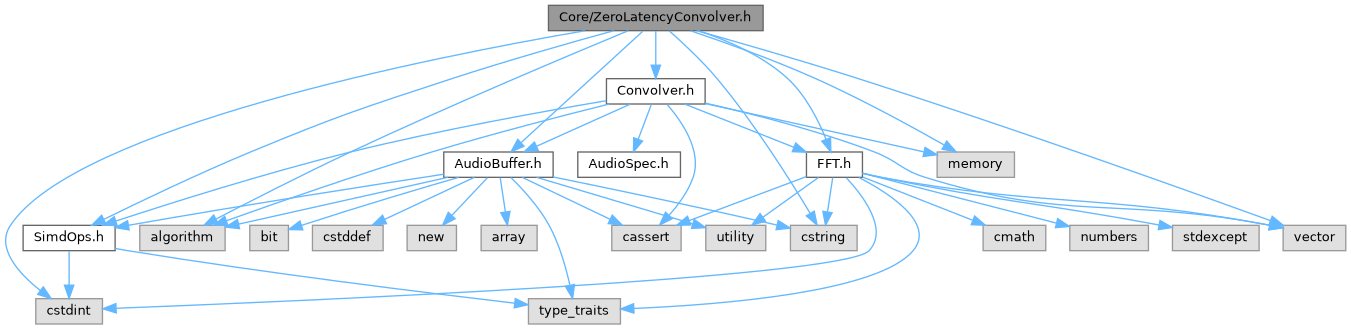
Go to the source code of this file.
Classes | |
| class | dspark::ZeroLatencyConvolver< T > |
| Gardner-style non-uniform partitioned convolver (zero latency, flat CPU). More... | |
Namespaces | |
| namespace | dspark |
| Main namespace for the DSPark framework. | |
Detailed Description
Zero-latency non-uniform partitioned convolution (Gardner scheme).
Convolves arbitrarily long impulse responses with zero input/output delay and flat CPU usage, after W. G. Gardner, "Efficient Convolution without Input-Output Delay", JAES 43(3), 1995. The IR is split into three regions, each handled by the cheapest method that meets its deadline:
[0, 128) direct FIR head (SIMD dot product) – latency 0 [128, 2048) uniform partitioned FFT, block 128 – result lands exactly when needed (offset == its block latency) [2048, end) FFT partitions of 1024, time-distributed: each cycle's work (FFT + per-partition spectral MACs + IFFT + overlap- add) is split into units executed under a per-sample budget across the following 1024 samples, so long IRs never spike a single audio callback
The tail partitions start at twice their block size, which is what creates the full block of scheduling slack the time distribution relies on – the core idea of Gardner's non-uniform scheme.
Compared to the uniform Convolver (latency = block size), the price of zero latency is the direct head (~128 MACs per sample). Use this class for monitoring paths, cabinet simulation and anywhere latency matters; the plain Convolver remains the cheapest choice when block-size latency is acceptable.
Mono engine: one instance convolves one channel (like Convolver).
Dependencies: Convolver.h, FFT.h, SimdOps.h, AudioBuffer.h.
Definition in file ZeroLatencyConvolver.h.