Wave Digital Filters: physical circuit modelling building blocks. More...
#include "DspMath.h"#include <algorithm>#include <array>#include <cassert>#include <cmath>#include <tuple>#include <utility>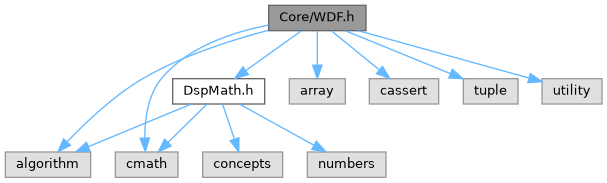
Go to the source code of this file.
Classes | |
| class | dspark::wdf::Resistor< T > |
| Ideal resistor. Absorbs its incident wave (b = 0). More... | |
| class | dspark::wdf::Capacitor< T > |
| Capacitor, bilinear discretization: b[n] = a[n-1], Rp = 1/(2 fs C). More... | |
| class | dspark::wdf::Inductor< T > |
| Inductor, bilinear discretization: b[n] = -a[n-1], Rp = 2 fs L. More... | |
| class | dspark::wdf::ResistiveVoltageSource< T > |
| Voltage source with series resistance (Thévenin leaf): b = Vs. More... | |
| class | dspark::wdf::Series< T, Child1, Child2 > |
| Adapted three-port series connector. More... | |
| class | dspark::wdf::Parallel< T, Child1, Child2 > |
| Adapted three-port parallel connector. More... | |
| class | dspark::wdf::Inverter< T, Child > |
| Two-port polarity inverter (flips the connected subtree's polarity). More... | |
| class | dspark::wdf::IdealVoltageSourceRoot< T, Tree > |
| Ideal voltage source closing a linear tree: b = 2 Vs - a. More... | |
| class | dspark::wdf::DiodePairRoot< T, Tree > |
| Antiparallel diode pair root (the classic clipper nonlinearity). More... | |
| class | dspark::wdf::DiodeRoot< T, Tree > |
| Single Shockley diode root: i(v) = Is (e^{v/(n Vt)} - 1). More... | |
| class | dspark::wdf::RType< T, Children > |
| N-port R-type adaptor for non-series/parallel interconnections. More... | |
| class | dspark::wdf::ToneStackFMV< T > |
| Exact Fender '59 Bassman treble/bass/middle tone stack. More... | |
Namespaces | |
| namespace | dspark |
| Main namespace for the DSPark framework. | |
| namespace | dspark::wdf |
| namespace | dspark::wdf::detail |
Detailed Description
Wave Digital Filters: physical circuit modelling building blocks.
Implements the classical WDF toolkit (Fettweis 1986): one-port elements (resistor, capacitor, inductor, resistive voltage source), adapted three-port series/parallel connectors, a polarity inverter, and circuit roots – an ideal voltage source for linear networks and Newton-Raphson nonlinear roots (Shockley diode, antiparallel diode pair).
Wave convention: voltage waves with a = v + R*i (incident) and b = v - R*i (reflected), so v = (a+b)/2 and i = (a-b)/(2R). Reactances use the bilinear (trapezoidal) discretization: a WDF network is therefore sample-exact against the bilinear transform of its analog transfer function, which is how this header is verified (RC and RLC against the analytic discrete response; diode clippers against a high-precision trapezoidal reference solve of the circuit ODE – the same integration SPICE .tran uses).
Trees are composed statically from references – no virtual dispatch, all scattering inlines. Per sample: call root.process() after updating source voltages, then read element voltages/currents.
Beyond series/parallel trees, the header provides an R-type adaptor (after K. Werner's thesis): an N-port connector for arbitrary – non series/parallel – topologies. Its scattering matrix is derived numerically from the interconnection network via Modified Nodal Analysis: each port is replaced by its instantaneous Thévenin equivalent (source a_i, resistance R_i), the linear node system is solved once per topology/parameter change, and S = 2M - I where M maps incident waves to port voltages. The up-facing port is adapted to the Thévenin resistance seen looking into the network, so R-types nest under any root. ToneStackFMV builds on it: the exact Fender '59 Bassman treble/bass/middle network (topology and verification transfer function after Yeh & Smith, DAFx-06).
Scope note: nonlinear roots cover one-port nonlinearities; multi-port nonlinear roots (triode inside the WDF tree) remain future work.
Dependencies: DspMath.h.
Definition in file WDF.h.