Topology-Preserving Transform (TPT) State Variable Filter. More...
#include "DspMath.h"#include "AudioSpec.h"#include "AudioBuffer.h"#include "DenormalGuard.h"#include <algorithm>#include <array>#include <cmath>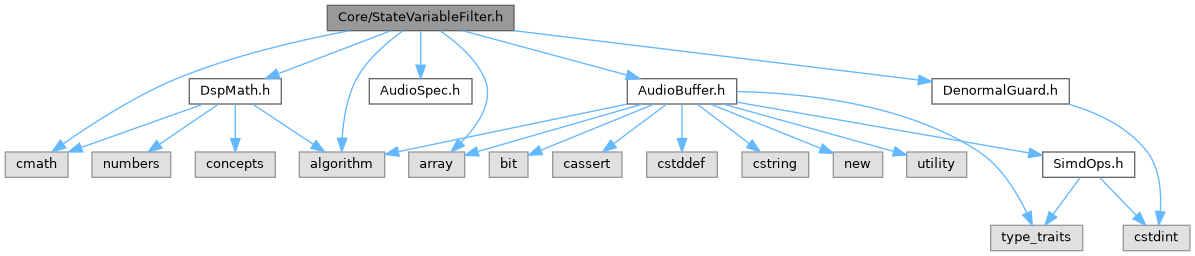
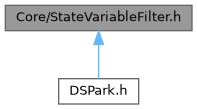
Go to the source code of this file.
Classes | |
| class | dspark::StateVariableFilter< T > |
| TPT State Variable Filter with simultaneous multi-output. More... | |
| struct | dspark::StateVariableFilter< T >::MultiOutput |
| Result struct for simultaneous multi-output processing. More... | |
| struct | dspark::StateVariableFilter< T >::ChannelState |
Namespaces | |
| namespace | dspark |
| Main namespace for the DSPark framework. | |
Detailed Description
Topology-Preserving Transform (TPT) State Variable Filter.
A 2nd-order multimode filter based on the Zavalishin/SVF topology. Produces lowpass, highpass, bandpass, notch, allpass, bell, low-shelf, and high-shelf outputs - all from the same structure, often simultaneously.
This is the fundamental building block for modular filter design. Unlike cascaded biquads, the SVF:
- Is modulation-friendly (cutoff can change every sample without artifacts)
- Provides simultaneous multi-output (LP + HP + BP in one processSample call)
- Uses zero-delay feedback (no unit-delay in the loop)
- Is numerically stable at all frequencies
Three levels of API complexity:
- Level 1:
svf.setCutoff(1000); svf.setMode(LP); svf.processBlock(buf); - Level 2:
auto [lp,hp,bp] = svf.processMultiOutput(x, ch); - Level 3: Inherit, access g_/R_/ic1eq_/ic2eq_ for custom topologies.
References:
- Zavalishin, "The Art of VA Filter Design" (2018), ch. 3-4
- Simper, "Solving the continuous SVF equations using trapezoidal integration" (cytomic technical paper, 2013)
Threading: owner-managed. prepare/reset are setup-time; all setters and process calls belong to the owning audio thread (see the class note). processBlock installs a DenormalGuard; per-sample callers are expected to guard their own callback (framework convention) - resonant tails decay through the denormal range otherwise.
Dependencies: DspMath.h, AudioSpec.h, AudioBuffer.h, DenormalGuard.h.
Definition in file StateVariableFilter.h.