Loading...
Searching...
No Matches
PitchFollower.h File Reference
Musical pitch tracker: PitchDetector + the logic that makes it usable. More...
#include "../Core/AudioBuffer.h"#include "../Core/AudioSpec.h"#include "../Core/DspMath.h"#include "PitchDetector.h"#include <algorithm>#include <atomic>#include <cmath>#include <cstddef>#include <cstdint>#include <limits>#include <span>#include <vector>
Include dependency graph for PitchFollower.h:

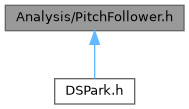
This graph shows which files directly or indirectly include this file:
Go to the source code of this file.
Classes | |
| class | dspark::PitchFollower< T > |
| Gated, octave-safe, semitone-smoothed pitch tracking source. More... | |
Namespaces | |
| namespace | dspark |
| Main namespace for the DSPark framework. | |
Detailed Description
Musical pitch tracker: PitchDetector + the logic that makes it usable.
A raw pitch detector is not directly usable as a modulation source: it reports octave errors on transients, garbage with high confidence during noise bursts, and jumps that would make any controlled parameter zipper. PitchFollower wraps Analysis/PitchDetector.h with the control logic every pitch-driven effect needs:
- Confidence gating - readings below the confidence threshold (or outside the configured frequency range) never move the output; the last reliable pitch is held through consonants and silence.
- Octave-jump correction - a reading ~1-2 octaves away from the tracked pitch is folded back to the closest octave of the current target before being considered (the classic YIN 2x/0.5x failure on transients).
- Jump confirmation - a genuinely large interval must persist for three consecutive readings before the target moves (one bad frame never jerks the output).
- Glide in semitone domain - the public value slews toward the target at a constant rate expressed in milliseconds per octave, so the movement is musically uniform across the whole range (Hz-domain smoothing is faster at high pitches and sluggish at low ones).
Threading:
- prepare(): setup thread (allocates; not concurrent with processing).
- processBlock() / pushSamples() / reset(): audio thread (stream owner).
- setRange() / setConfidence() / setGlide(): any thread (relaxed atomics; non-finite values are ignored).
- getSmoothedHz() / getRawHz() / getConfidence() / isTracking() and the parameter getters: any thread, lock-free.
follower.prepare(spec);
follower.setRange(70.0f, 800.0f); // vocal range
follower.setGlide(60.0f); // ms per octave
// per block:
follower.processBlock(buffer); // internal mono sum
eq.setFrequency(follower.getSmoothedHz() * 0.9f); // low-cut under tonic
Dependencies: PitchDetector.h, AudioSpec.h, AudioBuffer.h, DspMath.h.
Definition in file PitchFollower.h.