FIR (Finite Impulse Response) filter with windowed-sinc coefficient design. More...
#include "AudioBuffer.h"#include "SimdOps.h"#include "WindowFunctions.h"#include <algorithm>#include <atomic>#include <cassert>#include <cmath>#include <numbers>#include <span>#include <vector>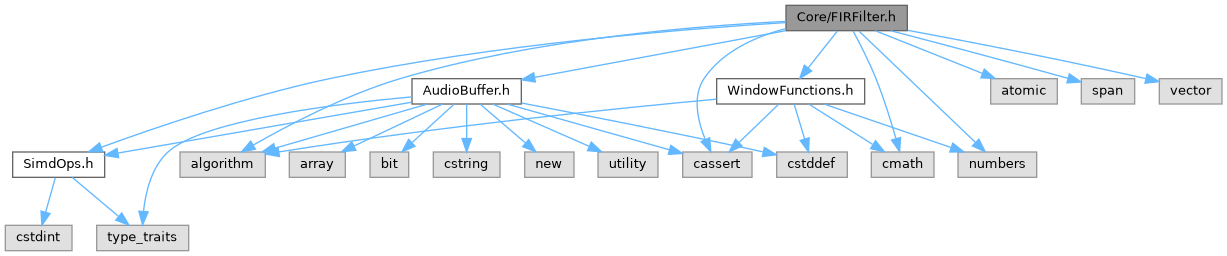
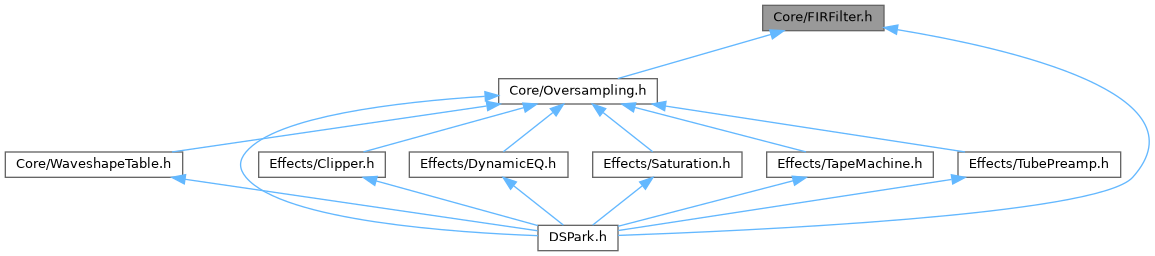
Go to the source code of this file.
Classes | |
| class | dspark::FIRDesign< T > |
| Static methods for designing FIR filter coefficients. More... | |
| class | dspark::FIRFilter< T > |
| FIR filter using direct-form convolution with a mirrored delay line. More... | |
Namespaces | |
| namespace | dspark |
| Main namespace for the DSPark framework. | |
Detailed Description
FIR (Finite Impulse Response) filter with windowed-sinc coefficient design.
FIR filters provide linear phase response – they do not distort the phase of the signal. This makes them essential for:
- Mastering-grade equalisation
- Linear-phase crossovers
- Sample rate conversion (anti-aliasing)
- Any application where phase accuracy matters
Trade-offs vs IIR (Biquad):
| IIR (Biquad) | FIR | |
|---|---|---|
| Phase | Non-linear | Linear (symmetric) |
| Efficiency | Very few coefficients | Many coefficients needed |
| Latency | Minimal | N/2 samples |
| Stability | Always stable | Always stable |
For short FIR filters (<= ~256 taps), direct convolution is used via the FIRFilter class, which features a lock-free ping-pong coefficient publish for safe real-time updates and SIMD (simd::dotProduct) convolution.
Coefficient design (FIRDesign) always runs its maths in double precision and casts to T on return: design is setup-time work, so float builds get full float accuracy for free.
Dependencies: WindowFunctions.h, SimdOps.h, AudioBuffer.h.
Definition in file FIRFilter.h.